Check engine light meaning is one of the most common questions Orlando drivers ask us — here’s what you need to know.
A check engine light means your vehicle’s computer has detected something outside normal range, from a loose gas cap to a serious engine problem — the light alone doesn’t tell you which. A steady light usually means it’s safe to drive to a shop soon; a flashing light means stop and get it scanned right away. In Orlando, a professional diagnostic scan typically costs $50–$150, though many shops apply that fee toward the repair if you move forward.
Getting check engine light meaning right the first time — rather than paying for a repeat repair — is exactly why an accurate diagnosis matters before any work begins.
Check engine light meaning: What the Check Engine Light Actually Means
Every vehicle built since the mid-1990s uses an OBD2 (On-Board Diagnostics, second generation) system that constantly monitors engine, transmission, and emissions performance. When a sensor reading falls outside its expected range, the computer stores a trouble code and lights up the check engine light on your dashboard.
The light itself is just a notification — it can’t tell you the severity of the problem. That’s why guessing based on symptoms alone is risky; a scan tool that reads the actual stored code is the only reliable starting point.
Common OBD2 Code Categories Explained
OBD2 codes follow a standardized format that starts with a letter and four numbers. Understanding the category tells you roughly what system is affected, even before a full diagnosis:
This is a point where check engine light meaning decisions really matter — a correct call here avoids paying twice.
- P0xxx codes (Generic Powertrain) — Standardized codes covering the engine and transmission, recognized across all manufacturers. These include common issues like misfires, fuel trim problems, and evaporative emissions faults.
- P1xxx codes (Manufacturer-Specific Powertrain) — Similar territory to P0xxx codes, but defined uniquely by each automaker, often requiring manufacturer-specific diagnostic data to interpret correctly.
- P04xx codes (Emissions-Related) — Cover the catalytic converter, EGR system, and evaporative emissions system. These rarely cause a breakdown but can affect fuel economy and will fail an emissions-relevant inspection in states that require one.
- P01xx–P03xx codes (Fuel and Air Metering / Ignition) — Relate to sensors like the mass airflow sensor, oxygen sensors, and ignition system components such as spark plugs and coils.
- B-codes (Body) — Cover body-related electronics like airbags, power windows, and climate control.
- C-codes (Chassis) — Cover ABS, traction control, and suspension-related electronics.
- U-codes (Network/Communication) — Indicate a communication failure between the vehicle’s onboard computer modules.
A code number alone is a starting point, not a diagnosis. Two vehicles can throw the identical code for completely different underlying reasons, which is why a proper diagnostic goes beyond just reading the code.
This is a point where check engine light meaning decisions really matter — a correct call here avoids paying twice.
What a Professional Diagnostic Scan Involves
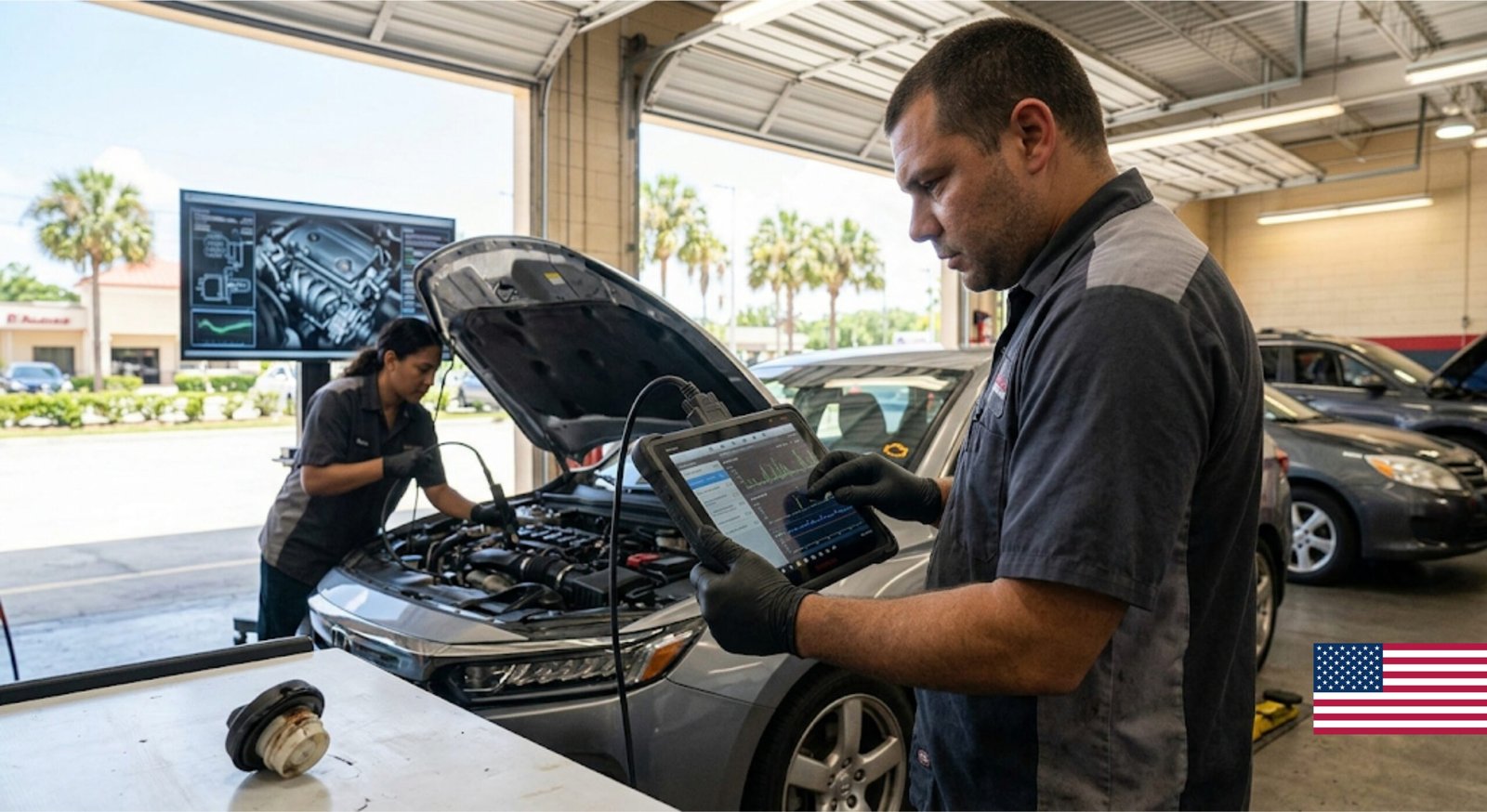
A thorough check engine light diagnostic is more than plugging in a code reader. It typically includes:
- Retrieving all stored codes, including pending and freeze-frame data that captures conditions when the fault occurred
- Reviewing live sensor data to see how the engine is actually performing in real time
- Visual inspection of related components (wiring, vacuum lines, connectors) tied to the code
- Cross-referencing the code against manufacturer technical service bulletins for known issues on that specific model
- A test drive, when appropriate, to confirm the fault is still present or reproducible
This is different from the free code-read some parts stores offer, which typically just tells you the code number without the deeper investigation needed to confirm the actual cause.
This is a point where check engine light meaning decisions really matter — a correct call here avoids paying twice.
Is It an Emergency, or Can It Wait?
Emergency (Stop Driving)
- Flashing check engine light — indicates an active misfire that can damage your catalytic converter within minutes
- Check engine light paired with loss of power, unusual noises, or a burning smell
- Check engine light paired with an overheating warning
Can Usually Wait for a Scheduled Appointment
- Steady check engine light with no other symptoms
- Light triggered after a fuel fill-up (often a loose or faulty gas cap)
- Mild performance changes like slightly reduced fuel economy
Even in the “can wait” category, don’t wait indefinitely — codes related to emissions or sensor drift often get worse and more expensive the longer they’re ignored.
This is a point where check engine light meaning decisions really matter — a correct call here avoids paying twice.
2026 Diagnostic Cost Guide (Orlando, FL)
| Service | Typical Cost Range |
|---|---|
| Basic code scan/read | $50 – $100 |
| Full diagnostic with live data + inspection | $80 – $150 |
| Diagnostic fee (often credited toward repair) | Varies by shop policy |
Ask upfront whether the diagnostic fee is applied toward the repair cost if you proceed — this is common practice at many Orlando shops and can make a proper diagnosis essentially free if you move forward with the fix.
This is a point where check engine light meaning decisions really matter — a correct call here avoids paying twice.
Florida’s Emissions Rules and the Check Engine Light
Florida does not require an annual state-mandated safety or emissions inspection for privately owned passenger vehicles, unlike some other states. That means a check engine light here won’t stop you from renewing your registration. It doesn’t mean an emissions-related code is safe to ignore, though — a failing catalytic converter or oxygen sensor still hurts fuel economy, can affect resale value, and may eventually cause a noticeable performance problem even without a state inspection forcing the issue.
This is a point where check engine light meaning decisions really matter — a correct call here avoids paying twice.
This is a point where check engine light meaning decisions really matter — a correct call here avoids paying twice.
Why the Light Sometimes Comes Back After a Repair
If your check engine light returns shortly after a repair, it doesn’t always mean the fix failed. The vehicle’s computer runs background checks called readiness monitors that need several drive cycles under specific conditions to confirm a repair fully resolved the fault. A reputable shop will explain whether your light should stay off immediately or whether it needs a few days of normal driving to confirm the fix held.
Why Local Diagnosis Matters in Orlando
Florida’s heat and humidity add wrinkles that a generic code lookup online can’t account for — evaporative emissions codes, for example, are more common in high-humidity climates due to condensation affecting sensors and seals. A shop that regularly diagnoses vehicles in Central Florida’s conditions has seen these patterns before.
MCS Mechanical’s multilingual team can walk you through exactly what your code means in plain English, Spanish, or Portuguese before you approve any work, and as Orlando’s certified engine and transmission warranty specialist, backed by Technet’s nationwide 24-month/24,000-mile warranty, any repair performed is documented properly — which matters if you ever need to reference it for a future warranty claim.
Related reading: Engine misfire repair guide
For general vehicle safety and maintenance guidance, the National Highway Traffic Safety Administration (NHTSA) recommends addressing warning signs like these promptly rather than waiting for a breakdown.
Frequently Asked Questions
Is it safe to drive with the check engine light on?
If the light is steady and the car drives normally, it’s usually safe to schedule a diagnostic soon. If the light is flashing or paired with power loss, noise, or overheating, stop driving and have it towed or scanned immediately.
How much does it cost to diagnose a check engine light in Orlando?
A professional diagnostic scan typically costs $50–$150, depending on how thorough the inspection is. Many shops apply this fee toward the repair cost if you proceed, so ask about that policy upfront.
Can a loose gas cap really trigger the check engine light?
Yes. A loose, cracked, or missing gas cap breaks the evaporative emissions system’s seal, which is one of the most common and least expensive causes of a check engine light.
Will the check engine light turn off on its own?
Sometimes, if the triggering condition resolves itself (like tightening a gas cap) and the computer completes several successful drive cycles without detecting the fault again. It won’t turn off if the underlying problem is still present.
Check engine light on and not sure what it means? Call MCS Mechanical at 407-853-0002 or message us on WhatsApp for a professional diagnostic scan and a plain-language explanation before you approve any repair.