If your dashboard warning lights start flickering, your power windows quit, or your car cranks but won’t start in Orlando’s summer heat, the question on your mind is usually the same: does extended warranty cover electrical repairs, or is this coming out of your pocket? The honest answer is ‘it depends’ — on your plan tier, on exactly what failed, and on how well that failure gets diagnosed and documented before the claim is filed. At MCS Mechanical, a TechNet Certified shop located at 2699 Old Winter Garden Rd in Orlando, FL, we submit electrical warranty claims to insurers on a weekly basis, and we can tell you from experience that electrical repairs are one of the toughest categories to get approved. This guide walks through what’s typically covered, what usually gets denied, and how proper diagnostics can be the difference between an approved claim and a rejected one.
Does Extended Warranty Cover Electrical Repairs? The Short Answer
Whether your contract answers ‘yes’ to extended warranty covering electrical repairs depends almost entirely on the type of plan you purchased. Basic powertrain plans usually only cover electrical components that are directly tied to the engine or transmission’s operation — think the alternator or starter motor. Mid-tier ‘stated component’ plans list out specific covered parts, and electrical items may or may not make that list. Comprehensive or exclusionary plans (the higher-tier contracts sold by providers like AGWS, Protective, and Secure One) cast a much wider net, often including power window motors, door lock actuators, and even the vehicle’s onboard computer modules. Before you assume anything is or isn’t covered, pull out your contract and look at the component list — or give us a call at (407) 853-0002 and we can help you read it.
Electrical Components Extended Warranties Typically Cover
Most extended service contracts fall somewhere between bare-bones powertrain coverage and full comprehensive protection. Here’s where electrical components generally land.
Charging and Starting System Components
The alternator and starter motor are two of the most commonly approved electrical repairs under extended warranties, including many basic powertrain plans, because they’re considered essential to the vehicle actually running. If your alternator’s diode assembly fails or your starter’s solenoid burns out from normal wear, that’s usually a straightforward approval — as long as it’s properly diagnosed and documented as a component failure rather than a symptom of neglect.
Wiring Harnesses, Computer Modules, and Sensors
Wiring harness failures caused by a manufacturing defect (poor insulation, a factory splice that corrodes prematurely, a chafe point built in at the factory) are typically covered, though insurers will scrutinize these closely to rule out an outside cause like water intrusion or rodent damage. On mid-to-higher tier plans, the ECU and other onboard computer modules are often covered, particularly when a documented fault directly caused the module to fail. Sensors are usually covered when they’re tied to a system the contract already covers — for example, a crankshaft position sensor tied to a covered engine, or a wheel speed sensor tied to a covered ABS module.
- Alternator and starter motor failures from normal wear
- Wiring harness failures traced to a manufacturing defect
- Power window motors and door lock actuators (comprehensive/exclusionary plans)
- ECU and body control modules (higher-tier comprehensive plans)
- Sensors directly tied to an already-covered system
If you’re dealing with any of the above, our electrical repair services in Orlando team can run a full diagnostic and tell you, in plain language, whether what failed lines up with what your contract is designed to cover.
What’s Typically Excluded or Gets Denied
Just as important as knowing what’s covered is knowing what almost never is. These are the electrical claim scenarios we see denied most often here in Orlando.
- Corrosion from water intrusion or flood damage — a real risk in Florida after heavy storms, and one of the most common denial reasons
- Aftermarket electronics or wiring — stereo systems, alarms, remote starters, trailer wiring, and lift kit wiring harnesses are not covered
- Damage from a dead battery that wasn’t addressed promptly — a parasitic drain left unresolved can fry modules, and insurers treat that as an owner-maintenance failure
- Rodent damage to wiring — increasingly common in Florida, where warm engine bays attract rats and other pests, but almost universally excluded as ‘outside cause’ damage
- Blown fuses from user error — overloading a circuit with an aftermarket accessory typically voids that specific claim
- Pre-existing electrical gremlins not disclosed at purchase — if there’s evidence the issue existed before the contract started, expect a denial
Why Electrical Claims Are Harder to Get Approved Than Mechanical Ones
Ask any shop that handles a lot of warranty work and they’ll tell you the same thing: electrical claims get pushed back on far more often than a straightforward mechanical failure like a water pump or a transmission. The reason comes down to documentation. A cracked block or a seized compressor is visible and undeniable. An intermittent electrical fault — a wire that only opens up when it’s hot, a module that resets itself and clears its own fault code, a short that only shows up over bumps — is genuinely difficult to reproduce on demand. If a technician can’t capture the fault in the act, an adjuster has nothing concrete to approve, and a vague diagnosis of ‘electrical issue’ or ‘check engine light’ is almost guaranteed to get flagged or denied outright. This is exactly the kind of gap our guide to technical mistakes that get warranty claims denied covers in more detail.
How MCS Mechanical Documents Electrical Repairs to Maximize Approval Odds
This is where our shop’s approach makes a real difference. As a TechNet Certified facility, we don’t submit a claim based on a guess — we build a documented case around the exact failed component.
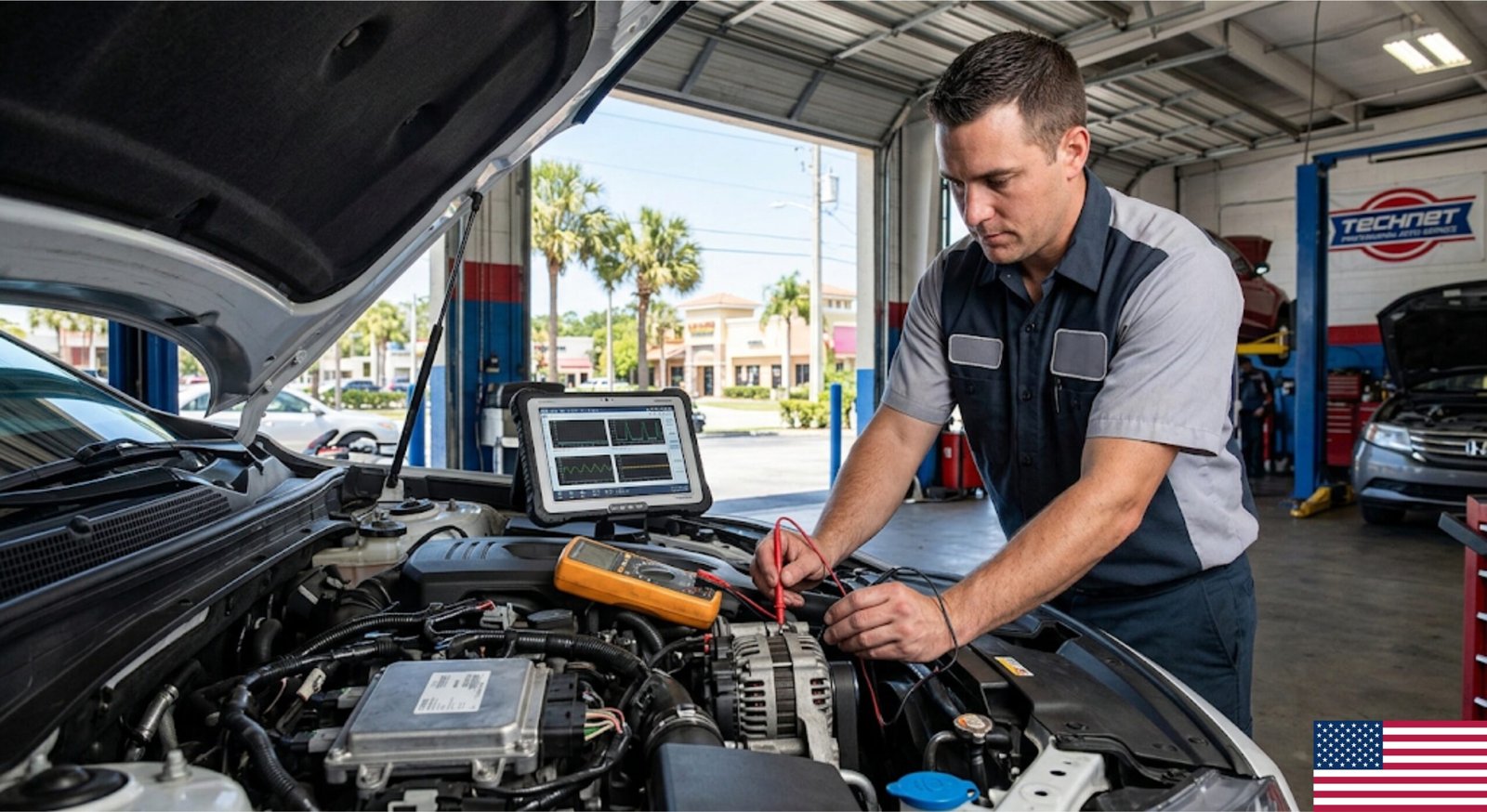
- Multimeter and oscilloscope readings — we capture actual voltage, resistance, and waveform data at the moment of failure or during a simulated failure condition, not just a fault code
- OEM wiring diagram cross-referencing — we trace the exact circuit back to its source so we can show the failure sits inside a covered component, not downstream of an aftermarket add-on
- Isolating the exact failed part — instead of writing up ‘electrical issue’ or ‘check engine light on,’ our diagnostic notes name the specific part: for example, ‘alternator diode rectifier failure confirmed via AC ripple voltage test,’ which gives the insurer something concrete to approve
We’ve built working relationships with most of the major warranty providers, including AGWS, Protective, and Secure One, and we know what each of them expects to see on a claim before they’ll sign off. If your vehicle is showing electrical symptoms and you’re not sure who your provider is or what they’ll require, call us at (407) 853-0002 and we’ll help you figure it out before you file anything. You can also see the full list of insurers we regularly work with on our extended warranty page.
Likely Covered vs Likely Denied: Electrical Repair Scenarios
| Electrical Scenario | Likely Outcome | Why |
|---|---|---|
| Alternator fails from normal wear at 45,000 miles | Likely Covered | Considered essential to vehicle operation; covered on most plan tiers |
| Starter motor intermittently fails to engage | Likely Covered | Covered if documented as a component failure with diagnostic evidence |
| ECU failure confirmed by scan tool and voltage testing | Likely Covered (comprehensive plans) | Often excluded on basic powertrain-only plans |
| Power window motor burns out | Likely Covered (comprehensive/exclusionary plans) | Usually excluded on powertrain-only plans |
| Wiring harness chewed by rodents | Likely Denied | Classified as outside/environmental cause, not a component defect |
| Corrosion on connectors after flood exposure | Likely Denied | Water/flood damage is a standard exclusion |
| Blown fuse from aftermarket stereo install | Likely Denied | Aftermarket modification voids coverage on that circuit |
| Module damage traced to a long-ignored dead battery | Likely Denied | Treated as an owner-maintenance failure, not a defect |
| Sensor failure on a system already covered by the contract | Likely Covered | Approved when isolated with diagnostic readings tying it to a covered system |
What to Do If Your Electrical Claim Gets Denied
A denial isn’t always the end of the road. Start by asking the insurer for the specific denial reason in writing, then compare it against your contract’s component list and exclusions. Many denials come down to a documentation gap rather than an actual exclusion — which is fixable with a follow-up diagnostic. Our denial-mistakes guide walks through the most common technical reasons claims get rejected and how to challenge them. If you believe your provider is acting in bad faith or misrepresenting your contract terms, you can also file a complaint with the Consumer Financial Protection Bureau or check the provider’s standing with the Better Business Bureau before escalating further.
Frequently Asked Questions
Does extended warranty cover electrical repairs in Orlando?
Often, yes — but coverage depends heavily on your plan tier and the specific component that failed. Powertrain plans cover a narrow list of electrical parts tied to engine operation, while comprehensive and exclusionary plans cover a much broader range, including window motors and computer modules.
Will my extended warranty cover a dead alternator?
In most cases, yes. Alternator failures from normal wear are among the most commonly approved electrical claims because the part is essential to the car running at all.
Is a wiring harness covered under extended warranty?
Only if the failure is traced to a manufacturing defect. If the harness was damaged by rodents, water intrusion, or an aftermarket installation, it typically won’t be covered.
Does extended warranty cover power windows or door locks?
Usually only on comprehensive or exclusionary plans. Basic powertrain contracts almost never include power accessories like window motors or door lock actuators.
Why was my electrical claim denied?
The most common reasons are a vague diagnosis (like ‘electrical issue’ instead of a named part), evidence of corrosion or water damage, aftermarket wiring, or a failure pattern suggesting neglect, such as an ignored dead battery.
Does extended warranty cover rodent damage to wiring?
No. Rodent damage is treated as an outside cause rather than a mechanical defect, and it’s one of the most frequently denied electrical claims we see in Florida.
How can I get my electrical claim approved faster?
Bring the vehicle to a shop that can document the failure with actual diagnostic readings — multimeter and oscilloscope data, referenced wiring diagrams, and a specific named component — rather than a general ‘electrical issue’ writeup. That level of documentation is what adjusters need to approve a claim quickly.
Bring Your Vehicle in for an Electrical Diagnostic Before You File
If you’re dealing with an electrical problem and planning to file an extended warranty claim, the smartest first move is a proper diagnostic — not a guess. Our TechNet Certified technicians will isolate the exact failed component, document it the way insurers expect to see it, and back our own repair work with a 24-month parts and labor warranty. We speak English, Portuguese, and Spanish at the shop, so language is never a barrier to getting a straight answer. Stop by MCS Mechanical at 2699 Old Winter Garden Rd, Orlando, FL, Monday through Friday from 8am to 6pm or Saturday from 8am to 2pm, or call us at (407) 853-0002 to schedule your electrical diagnostic. You can also reach out anytime through our contact page.