If your check engine light just came on somewhere between the 408 and I-4, chances are someone has already told you to swing by an auto parts store for a free code check. That is a reasonable first step, but it is not the same thing as a real OBD-II diagnostic scan performed by a shop with professional-grade equipment. A quick plug-in code pull and a full diagnostic scan use the same port under your dashboard, but they are not the same service, and the difference can cost you hundreds of dollars if you get it wrong. In this guide, we will explain exactly what OBD-II is, what a basic code reader can and cannot tell you, and what a professional diagnostic scan actually checks before a technician ever recommends a repair.
What Is OBD-II, and Why Does It Matter for Your Orlando Vehicle?
OBD-II stands for On-Board Diagnostics, second generation. Every gasoline-powered car and light truck sold in the United States since 1996 has been required to use this standardized system, which means the diagnostic port under your dashboard, usually near the steering column, follows the same basic communication protocol no matter if you drive a Honda, a Ford, or a Toyota built for Orlando traffic. The system was originally created to help monitor emissions, but modern vehicles use the same network to report on nearly every computer-controlled system on the car.
Here is the part most drivers never learn: your vehicle is not run by one computer. It is run by a network of modules, often ten or more, each responsible for a different job. The engine control module manages fuel and ignition. The transmission control module manages shifting. Separate modules handle the anti-lock brakes, the airbags, power windows, climate control, and more. The OBD-II port is simply the doorway into that entire network, and what you see when you plug into it depends entirely on the tool on the other end of the cable.
What Does an OBD-II Diagnostic Scan Actually Check?
A proper OBD-II diagnostic scan is not just a search for one stored trouble code. When a technician connects a professional scan tool, they can pull information from across the vehicle’s network, not only the engine light system. A thorough diagnostic scan typically covers:
- Engine control module (fuel trims, misfire counters, sensor readings)
- Transmission control module (shift timing, torque converter behavior)
- ABS and brake system module (wheel speed sensors, hydraulic control)
- Airbag or SRS module (crash sensor data, seatbelt pretensioner status)
- Body control module (lighting, power accessories, security system)
- Live, real-time data streaming from multiple modules at once
- Freeze-frame data showing exact conditions when a fault occurred
- Bi-directional, active tests that command a component to operate
That last point is where a real diagnostic scan separates itself from a basic code check. A professional scan tool does not just read what the car reports; it can also send commands to the car, which lets a technician confirm a suspected failure instead of guessing.
Basic Code Reader vs. Professional Diagnostic Scan Tool
The $20 to $60 code readers sold at auto parts stores are useful tools, and we are not knocking them for what they are designed to do. The problem is that a lot of drivers, and honestly some quick-lube counters, treat the result as a finished diagnosis rather than a clue.
What a Basic Code Reader Shows You
A basic code reader typically talks to one module, almost always the engine control module, and pulls whatever generic trouble code is stored, something like P0300 or P0420. It displays a short, generic definition of that code, usually a single line of canned text. It cannot stream live data from multiple systems at once, it cannot access most manufacturer-specific codes, and it generally cannot command any component to turn on or off. It tells you that something tripped a threshold. It does not tell you why.
What a Professional-Grade Diagnostic Scan Tool Does
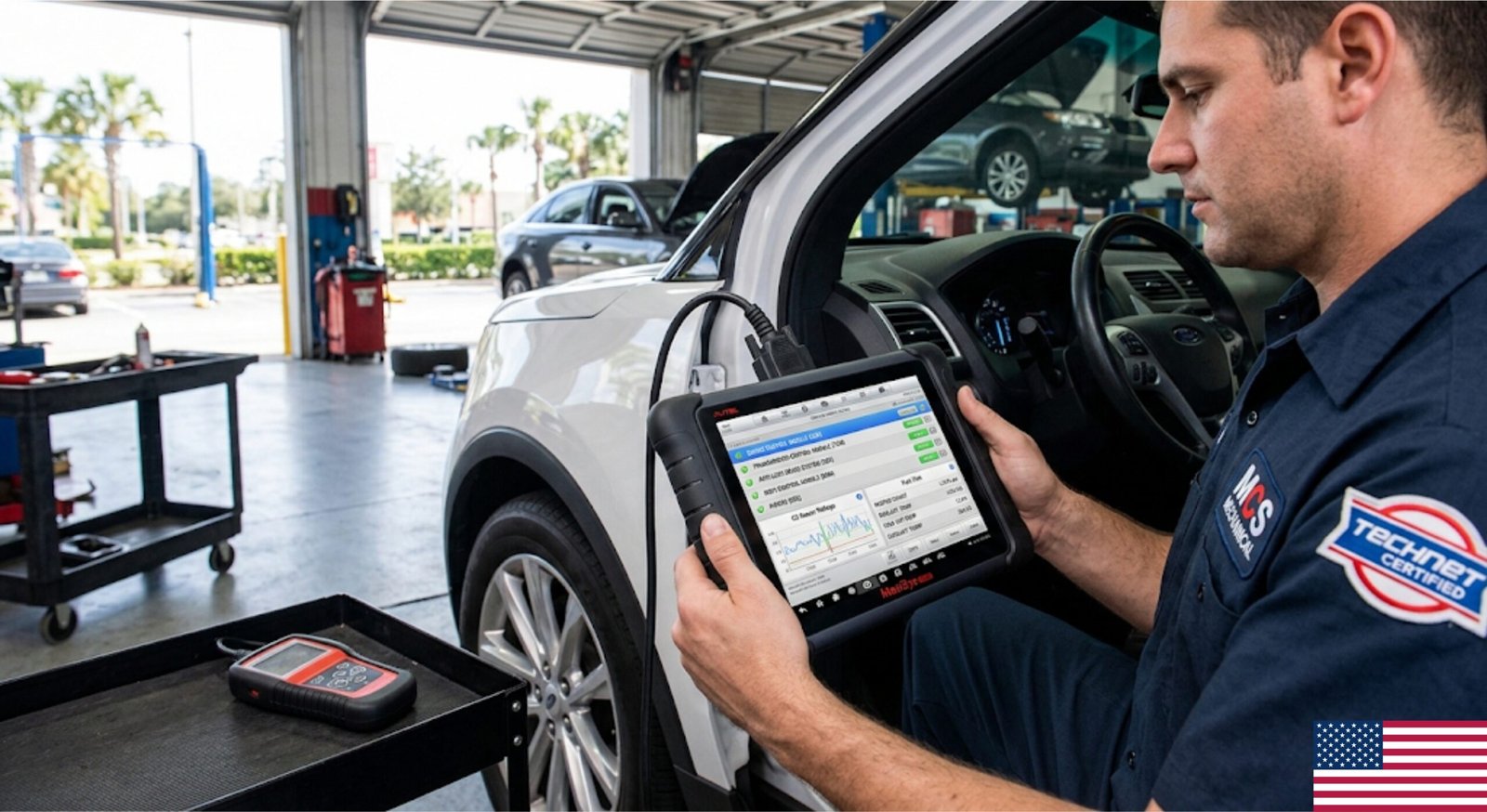
A professional diagnostic scan tool, in the hands of a trained technician, does far more. It can stream live sensor data from the engine, transmission, ABS, airbag, and body control modules simultaneously, which lets a technician watch how systems behave in real time, including while the vehicle is out on a test drive. It can pull freeze-frame data, a snapshot of engine speed, load, coolant temperature, fuel trim, and vehicle speed at the exact moment a fault was recorded. And it can run bi-directional, active tests, meaning the technician can command a fuel injector to fire, a cooling fan to turn on, or a solenoid to cycle, and watch how the vehicle actually responds. That is the difference between reading a symptom and confirming a failure.
| Capability | Basic Code Reader | Professional Diagnostic Scan |
|---|---|---|
| Reads generic trouble codes | Yes | Yes |
| Reads manufacturer-specific codes | Rarely | Yes |
| Multi-module coverage (engine, transmission, ABS, airbag, body) | No, usually engine only | Yes, all major modules |
| Live data streaming | Limited or none | Yes, real-time and simultaneous |
| Freeze-frame data | Basic or none | Full detail at time of fault |
| Bi-directional / active component tests | No | Yes |
| Technician interpretation | None, generic text only | Included, based on training and experience |
| Root-cause identification | No | Yes |
Why a Trouble Code Is a Starting Point, Not a Final Diagnosis
Every OBD-II trouble code has an official definition, but that definition describes a symptom the computer detected, not the part that failed. Codes are written broadly on purpose, because dozens of different problems can trigger the same threshold. That is exactly why replacing a part based on the code alone, without further testing, is one of the most common ways drivers end up paying twice for the same repair.
Real-World Example: What a P0420 Code Actually Means
P0420 is one of the most misunderstood codes on the road. The official definition is Catalyst System Efficiency Below Threshold, Bank 1. A basic code reader will show you that phrase and stop there. It sounds like it is pointing straight at the catalytic converter, so a lot of drivers, and some inexperienced shops, replace the converter first. But a P0420 can be triggered by several different underlying problems, including:
- An actual failing catalytic converter
- A failing upstream or downstream oxygen sensor giving inaccurate readings
- An exhaust leak near the sensors that lets outside air skew the readings
- Unrelated engine performance issues, such as a misfire or rich fuel condition, that damage the converter over time
A generic auto parts store scan cannot tell you which of these is actually happening. A professional diagnostic scan can, by streaming live oxygen sensor data from both sides of the converter, checking for exhaust leaks, and reviewing freeze-frame data to see what the engine was doing when the fault was recorded. That is the difference between guessing and knowing.
Why This Matters for Your Repair Bill and Your Warranty Claim
A new catalytic converter can run well over a thousand dollars installed. An oxygen sensor is often a fraction of that cost, and an exhaust leak repair can be less still. If you replace the converter based on a code alone and the real problem was a sensor or a leak, you have paid for a part you did not need, and the check engine light usually comes right back on. A proper diagnostic scan before any parts are ordered is what prevents that outcome.
The same logic applies to warranty and insurance claims. Extended warranty companies and insurers generally will not simply reimburse a repair because the check engine light was on and a part was swapped. They want documentation of an actual diagnostic process: which codes were present, what live data and freeze-frame information was reviewed, and what tests confirmed the failed component. At MCS Mechanical, our diagnostic work is documented for exactly this reason, and every repair we perform carries a 24-month parts and labor warranty. If you have questions about what a claim requires, call us at (407) 853-0002 and we will walk you through it.
When Should You Get a Professional Diagnostic Scan in Orlando?
You should ask for a full diagnostic scan any time a warning light comes on, whether it is the check engine light, the ABS light, the airbag light, or a transmission warning. It is also worth doing before buying a used vehicle, after a failed emissions test, or any time you have an intermittent problem that comes and goes without warning. If you are not sure what your dashboard is actually telling you, we also have a separate guide on this blog that walks through what the check engine light means and which situations call for immediate attention versus a scheduled visit. For the full picture on how our team approaches this kind of testing, visit our Electronic Diagnostics service page.
MCS Mechanical is TechNet Certified, and our shop at 2699 Old Winter Garden Rd in Orlando is set up to communicate with drivers in English, Portuguese, and Spanish, which matters in a city as diverse as ours. Whatever language you are most comfortable explaining your symptoms in, our team can walk you through the results in plain terms, not just a printout of codes.
Frequently Asked Questions
Is a diagnostic scan the same as a code reader check at an auto parts store?
No. A parts store reader pulls a generic code from the engine module and shows a short definition. A professional diagnostic scan checks multiple modules, streams live data, reviews freeze-frame conditions, and can run active tests to confirm the actual cause.
Can a diagnostic scan tell me exactly what part is broken?
A scan gives a technician the data needed to narrow down the cause, but it is combined with visual inspection, wiring checks, and sometimes further component testing before a part is confirmed as the culprit. The scan is the starting point of that process, not a replacement for it.
Why did my check engine light turn off after the parts store reset the code?
Clearing a code only erases the stored fault from memory. It does not fix the underlying problem. If the condition that caused the code is still present, the light will typically return within a few days of driving.
How long does a professional diagnostic scan take?
A basic scan can take as little as 20 to 30 minutes, but a thorough diagnostic that includes live data review, freeze-frame analysis, and any needed active tests or a test drive usually takes longer. We will always give you a time estimate before we start.
Do I need a diagnostic scan if my check engine light is not on?
Yes, in some cases. Certain faults, particularly in the transmission, ABS, or airbag systems, can trigger their own separate warning light instead of the check engine light. Intermittent issues can also set a code without the light staying on. A scan can catch stored history codes even after a light has gone out.
How much does a diagnostic scan cost at MCS Mechanical?
Pricing depends on the complexity of the vehicle and how much testing is needed to confirm a root cause. Call our shop at (407) 853-0002 and we can give you an accurate estimate based on your vehicle and symptoms.
Will a proper diagnostic scan save me money in the long run?
In most cases, yes. The cost of a proper scan is almost always less than the cost of replacing the wrong part based on a guess, and it also gives you documentation that helps with warranty or insurance claims if you need it later.
Get a Real Diagnostic Scan at MCS Mechanical
If a warning light is on, or your vehicle is doing something that does not feel right, do not let a guess turn into a second repair bill. Our TechNet Certified technicians use professional-grade diagnostic equipment to find the actual cause, not just the closest generic code, and every repair we perform is backed by a 24-month parts and labor warranty. Visit our Electronic Diagnostics service page to learn more, or call us directly at (407) 853-0002 to schedule a scan. You can also reach out anytime through our contact page. MCS Mechanical is located at 2699 Old Winter Garden Rd, Orlando, FL 32805, open Monday through Friday from 8am to 6pm and Saturday from 8am to 2pm, with staff who speak English, Portuguese, and Spanish.