
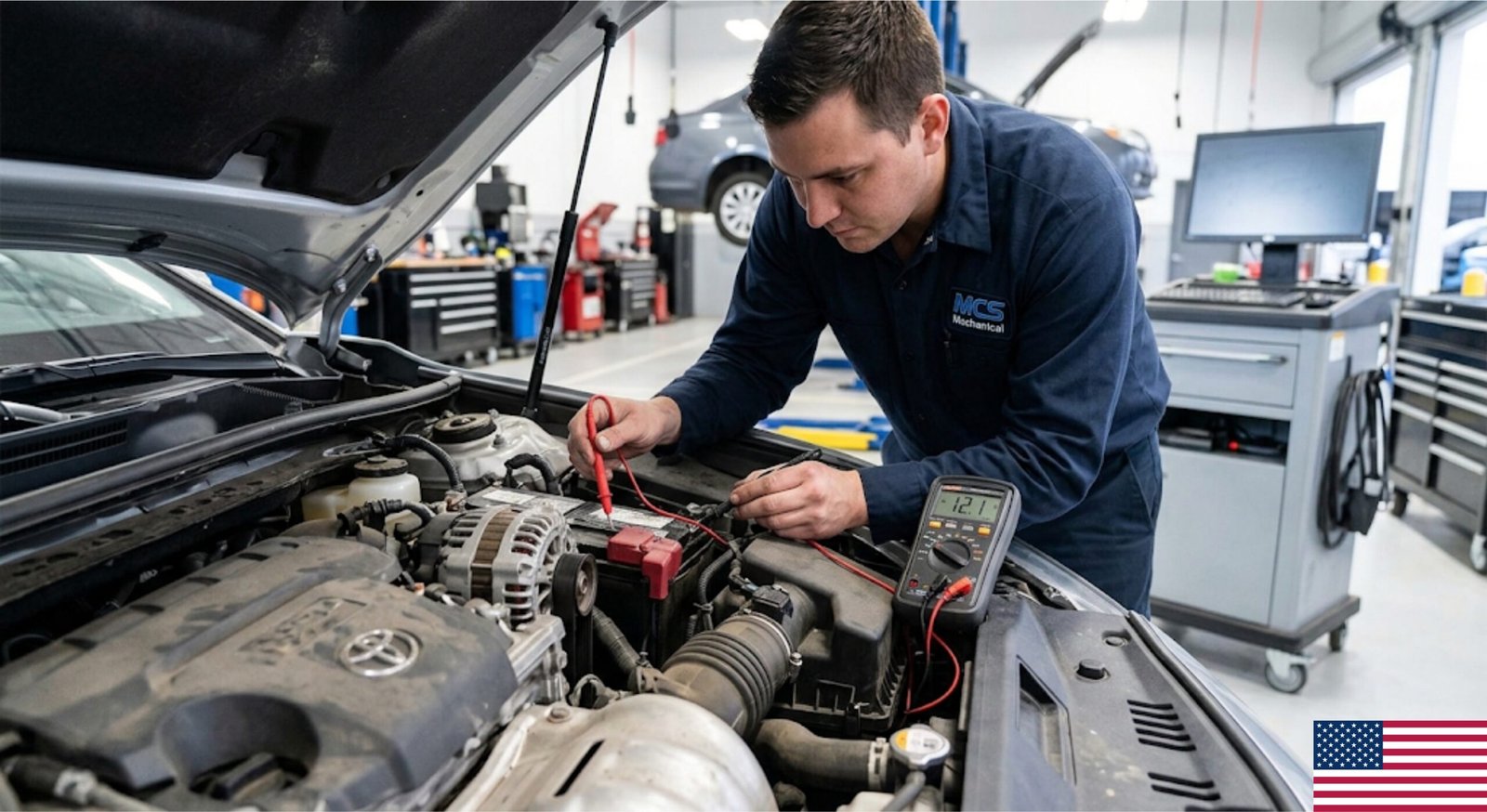
Multiple warning lights on at once on your dashboard is not something to brush off the way you might a single check engine light. When the check engine light, ABS light, traction control light, battery light, or temperature warning all pop on together, it usually means one shared problem is affecting several systems in your car at the same time, not four unrelated problems that happened to show up on the same day. At MCS Mechanical in Orlando, we get calls almost every week from drivers who say ‘my whole dashboard lit up out of nowhere’ and want to know if they can keep driving. Below we break down exactly what causes multiple warning lights to appear together, what to check before you call anyone, and when you should stop the car right now instead of driving another mile.
Why Multiple Warning Lights On at Once Is Different From a Single Light
A single check engine light usually means one sensor or one system tripped a fault code, and in a lot of cases the car is fine to drive for a few more days while you schedule a repair. Multiple warning lights on at once is a different story. Modern vehicles run a dozen or more separate computer modules for the engine, transmission, ABS, airbags, body, and instrument cluster, and those modules constantly talk to each other over a shared communication network. When several modules throw warning lights at the same moment, it almost always means something upstream is disrupting all of them: unstable voltage, a bad ground, a communication fault, or a mechanical problem that genuinely affects more than one system, like a transmission issue that also confuses the stability control. Treating each light as a separate problem and fixing them one at a time almost never works, because the lights keep coming back until the shared root cause is found.
The Most Common Causes of Several Dashboard Lights Turning On Together
In our shop, five causes account for the vast majority of multiple-warning-light visits. Here is what we look at first.
A Failing Alternator or Charging System
Your alternator does not just charge the battery, it supplies steady voltage to every module in the car while the engine is running. When it starts to fail, voltage swings up and down, and modules that are sensitive to voltage such as ABS, traction control, transmission control, and the engine computer can all set fault codes within minutes of each other. A failing alternator is one of the single most common reasons we see the battery light come on alongside the check engine light and one or two others.
A Bad Ground Connection or Corroded Wiring Harness
Most of a car’s electrical system relies on a handful of main ground points bolted to the body or engine block. If one of those grounds corrodes or loosens, several modules that share that ground point lose a clean electrical reference at once, which can trigger a whole cluster of unrelated-looking codes, including ABS, traction control, transmission, and even airbag warnings, that have nothing in common except the wiring path they share.
A Weak or Dying Battery
Even with a healthy alternator, a battery that can no longer hold a stable charge will cause voltage to dip every time a higher-draw component kicks on, like the AC compressor clutch or power steering assist. Those dips can be enough to make multiple modules briefly lose communication and log a fault, especially in older vehicles with more electrical demand than the battery was originally rated for.
A Blown Fuse on a Shared Circuit
Many vehicles group several modules on the same fuse or relay. A single blown fuse feeding that shared circuit can knock out or destabilize two or three systems simultaneously, which looks alarming on the dashboard but can sometimes be one of the simpler and less expensive fixes, once it is correctly diagnosed.
A Serious Drivetrain Fault
Sometimes multiple lights really do reflect one serious mechanical problem. A slipping transmission, for example, can trigger the transmission warning light, the check engine light, and the traction control or stability control light all at once, because the transmission control module shares data with the systems that manage wheel speed and power delivery. This combination tends to be the most urgent and the most expensive if ignored.
What to Do Right Now: Red Lights vs. Amber/Yellow Lights
The color of the lights on your dashboard tells you how much time you have.
- Red warning lights (oil pressure, coolant temperature, brake system, or battery/charge in some vehicles) mean stop driving as soon as you can do so safely. These indicate an immediate risk of engine damage, brake failure, or being stranded. Pull into a parking lot or safe shoulder, shut the engine off, and call for a tow or call us at (407) 853-0002 for guidance before you restart the car.
- Amber/yellow lights only (check engine, ABS, traction control, general battery indicator) generally mean it is safe to drive cautiously and directly to a shop, avoiding highway speeds, heavy acceleration, and long trips, but you should not put it off for weeks.
- Any combination that includes a red light should be treated as the red-light situation, even if three other lights on the same dash are only amber.
If you are not sure which category your combination falls into, call us at (407) 853-0002 and describe exactly which icons are lit. Our technicians can usually tell you over the phone whether it is safe to drive in.
Don’t Just Clear the Codes and Hope It Goes Away
It is tempting to plug in a cheap code reader, clear the codes, and see if the lights come back. Sometimes they do not come back for a few days, and it feels like the problem fixed itself. It did not. Clearing a code only erases the memory of the fault, it does nothing to the failing alternator, corroded ground, or weak battery that caused it in the first place. The same root cause will keep drawing down voltage or interrupting communication until it eventually causes a light to come back, often at a worse moment, like on the highway or right before a long trip. Multiple simultaneous lights are exactly the situation where clearing codes without finding the shared cause wastes time and money, because you are likely to pay for the same diagnostic twice.
Why Multiple Warning Lights Need a Full Multi-Module Scan, Not Just an Engine Code Check
A basic check-engine-only scan reads codes from one module: the engine computer. When multiple warning lights turn on together, the fault could be sitting in the ABS module, the body control module, the transmission control module, or in the wiring and grounds that connect all of them, and a single-module scan will miss it. Properly diagnosing multiple warning lights on at once means scanning every module in the vehicle, cross-referencing which systems reported faults at the same time, and testing the charging system, grounds, and shared circuits before replacing a single part. That is exactly what our electronic diagnostics service is built to do: a full system scan that finds the one root cause behind several warning lights instead of guessing which light to chase first. MCS Mechanical is TechNet Certified and every repair we perform carries a 24-month parts and labor warranty, so once we find and fix the actual cause, it is backed.
| Light Combination | Likely Root Cause | How Urgent |
|---|---|---|
| Check Engine + ABS + Traction Control | Wheel speed sensor fault or low system voltage confusing multiple modules | Moderate, schedule a scan within a few days |
| Battery Light + Check Engine + dimming interior lights | Failing alternator or charging system | High, get scanned within 24 hours |
| Check Engine + Transmission + Traction Control | Transmission fault also affecting stability control | High, limit driving and schedule soon |
| All lights flicker + gauges act erratic | Bad ground connection or corroded wiring harness | High, diagnose promptly |
| Multiple lights + slow power windows or radio resets | Weak or dying battery | Moderate to High |
| Check Engine + ABS + one accessory dead (locks, etc.) | Blown fuse on a shared circuit | Moderate |
| Red Oil Pressure + Temperature + Battery | Serious mechanical or electrical failure | Urgent, stop driving immediately |
Frequently Asked Questions
Why did all my warning lights come on at once?
The most common reasons are a failing alternator or charging system, a bad ground connection, a weak battery, a blown fuse feeding several modules, or a drivetrain problem that affects more than one system. A full multi-module scan is the fastest way to find which one applies to your car.
Is it safe to keep driving with multiple dashboard lights on?
It depends on the colors. If any red warning light (oil pressure, temperature, brakes) is part of the combination, stop driving and get it looked at before going further. If it is only amber/yellow lights like check engine, ABS, or traction control, you can usually drive cautiously and directly to a shop, but do not delay for weeks.
Can a dead or dying battery cause multiple warning lights?
Yes. A weak battery cannot keep voltage stable when other components draw power, and that instability can cause several modules to log faults at once, even if none of those modules are actually broken.
Will clearing the codes with a cheap scanner fix multiple warning lights?
No. Clearing codes only resets the warning, it does not repair the alternator, ground connection, fuse, or drivetrain issue that caused the fault in the first place. The lights typically come back, and the underlying problem keeps getting worse in the meantime.
Can a bad alternator really cause the ABS and traction control lights to come on?
Yes, this is one of the most common combinations we see. ABS and traction control modules are sensitive to voltage, so unstable output from a failing alternator can trip both of them along with the check engine and battery lights, even though the ABS system itself is fine.
How much does it cost to diagnose multiple warning lights?
Cost depends on how many modules and circuits need to be checked, but a proper multi-module diagnostic is far less expensive than replacing parts based on guesswork. Call us at (407) 853-0002 and we can give you a clear estimate before you bring the car in.
What should I do if a red brake, oil pressure, or temperature light comes on along with other lights?
Pull over safely as soon as possible and shut off the engine. Continuing to drive with a red warning light active risks serious engine damage or brake failure. Call (407) 853-0002 for guidance on towing or next steps.
Multiple warning lights on at once are your car telling you that something at the core of its electrical or drivetrain system needs attention now, not next month. Do not guess, and do not just clear the codes and hope for the best. Bring your vehicle to MCS Mechanical at 2699 Old Winter Garden Rd, Orlando, FL 32805 for a full multi-module electronic diagnostic scan. Our TechNet Certified technicians speak English, Portuguese, and Spanish, and every repair comes with a 24-month parts and labor warranty. Call us now at (407) 853-0002 or contact us online to get your car scanned before a simple fix turns into a breakdown. We are open Monday through Friday 8am to 6pm and Saturday 8am to 2pm.