Federal law is clearer on this than most drivers realize — and clearer than what you may have been told at a dealership service counter. Here is what actually protects your coverage, what a dealer has to prove before denying a claim, and the paperwork that settles the argument before it starts.
No. Does an independent shop void your warranty? Under the federal Magnuson-Moss Warranty Act, a manufacturer or dealer cannot void your factory warranty simply because an independent shop serviced your vehicle. To deny a specific claim, they must show that the outside work or part actually caused the failure. Your extended warranty contract, however, follows different rules.
Does an independent shop void your warranty? The federal rule, in plain language
The Magnuson-Moss Warranty Act — the 1975 federal law that governs consumer product warranties in the United States — prohibits a warrantor from requiring you to use a specific brand of part or a specific service provider to keep your warranty valid.
The statutory language is narrow and worth reading once. Section 2302(c) of Title 15 of the U.S. Code states:
“No warrantor of a consumer product may condition his written or implied warranty of such product on the consumer’s using, in connection with such product, any article or service (other than article or service provided without charge under the terms of the warranty) which is identified by brand, trade, or corporate name.”
Two things follow from that sentence. First, a carmaker cannot make dealer service a condition of your warranty. Second, there is one exception built into the text: the carmaker can require a specific part or service if it provides that part or service free of charge. If you are being charged for it, it cannot be a condition.
A warrantor can ask the Federal Trade Commission for a waiver, but it has to demonstrate that the product will not work properly without the specified item, and the FTC has to find the waiver in the public interest. These waivers are published in the Federal Register. They are rare.
Factory warranty and extended warranty are two different things
This is where most drivers get lost, and it is the single most useful distinction in this article. The Magnuson-Moss Warranty Act governs your factory warranty. Your extended warranty is a private contract, and it sets its own rules.
An extended warranty — more precisely, a vehicle service contract — is an agreement you bought from an administrator, often through the dealership at the time of purchase. It is not the manufacturer’s warranty, and the federal tie-in protection above does not translate to it line for line. What governs it is the contract you signed.
| Factory warranty | Extended warranty (vehicle service contract) | |
|---|---|---|
| Who backs it | The vehicle manufacturer | A third-party administrator |
| Main rules come from | Magnuson-Moss Warranty Act, 15 U.S.C. §2301 et seq. | The contract you signed |
| Can independent service void it outright? | No | Depends on the contract’s language |
| Who decides a claim | Manufacturer or its dealer | The administrator’s adjuster |
| Common requirement | Follow the maintenance schedule | Follow the maintenance schedule and often pre-authorization before work begins |
| Where to take a dispute in Florida | FTC; Florida Attorney General | The administrator’s appeal process; FDACS; Florida Attorney General |
Most contracts do not ban independent shops. What they almost always require is two things: that you kept up the manufacturer’s maintenance schedule and can show it, and that the shop calls for authorization before starting the repair. Skipping the authorization step is a far more common reason for a denial than the choice of shop.
That distinction matters in practice. If you are still inside the factory warranty, the federal rule protects your right to choose. If you are on an extended contract, your protection is the contract plus your records — which is why the last section of this article is about paperwork.
What a dealer has to prove before denying your claim
The burden of proof sits with the manufacturer or dealer, not with you. This is the part almost nobody is told at the counter.
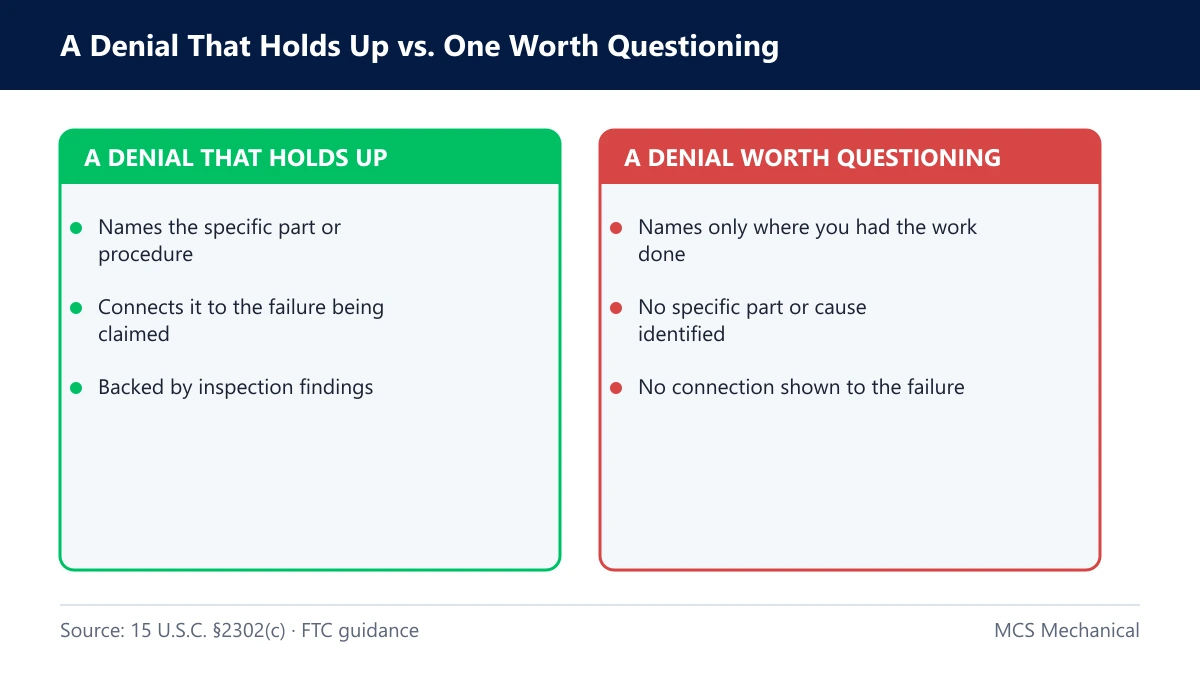
To deny a specific warranty claim on the grounds that outside work caused the problem, the dealer has to show that the independent shop’s work — or the specific aftermarket part installed — caused the failure being claimed. A general statement that you “went somewhere else” is not a basis for denial under the federal rule.
Read carefully, that means a denial should be specific. It should name a part or a procedure and connect it to the component that failed. “Your oil changes were done elsewhere” is not that. “The aftermarket water pump installed in March failed and caused the overheating damage you are now claiming” is.
The FTC has, over the years, sent warning letters to companies whose warranty language contradicted the tie-in provision. If a denial you receive is based on nothing more than where the service was performed, that is the specific thing worth pushing back on — in writing.
Four things that can actually cost you coverage
Choosing an independent shop is not on this list. These are:
- Skipped or undocumented maintenance. The most common real reason for a denial. If the contract requires service at a given interval and you cannot show it happened, the administrator has grounds. The service does not have to be at a dealer — it has to be documented.
- Starting the repair without authorization. On an extended contract, a repair begun before the administrator approves it is often excluded, regardless of who did the work or how correct the diagnosis was.
- A part or modification that demonstrably caused the failure. A specific, provable causal chain — not the mere presence of an aftermarket part.
- Damage from continued driving after a warning. Overheating is the textbook case. If a vehicle was driven after the temperature gauge went into the red, the resulting damage can be treated as neglect rather than mechanical failure. This one is worth taking seriously, because the driver’s decision in the first ten minutes often determines the claim.
The paperwork that ends the argument
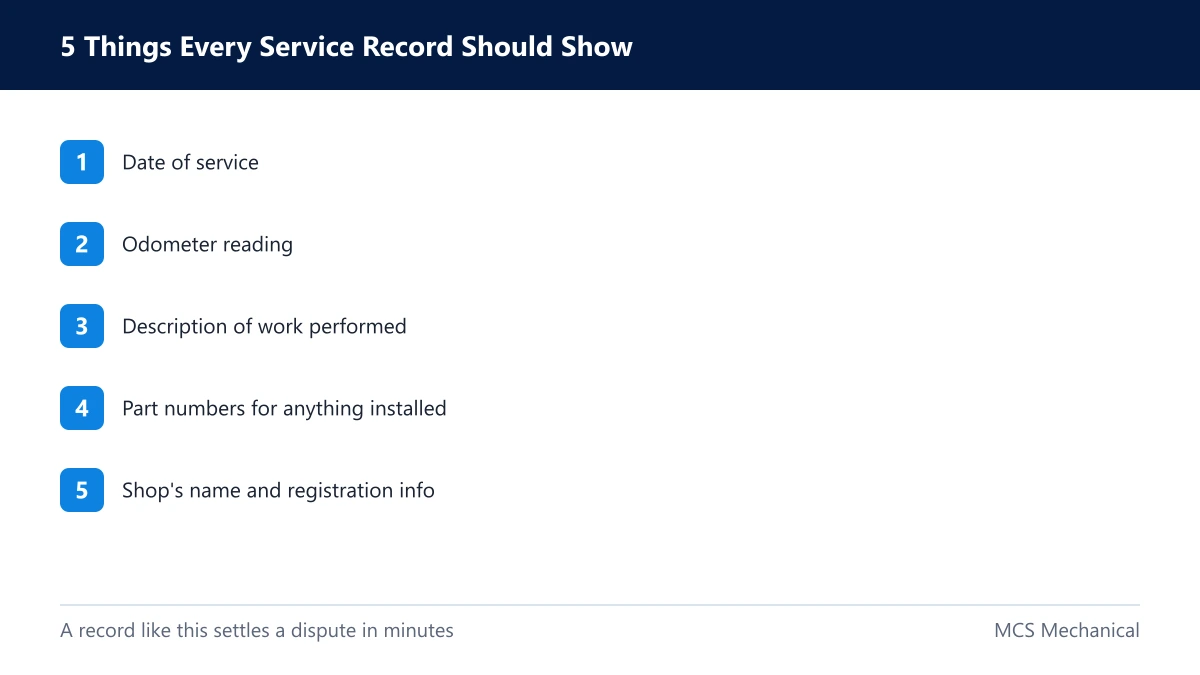
The most reliable protection is not an argument — it is a folder. Every service on your vehicle, wherever it is performed, should leave you with a document that shows five things:
- Date of the service
- Odometer reading at the time
- Description of the work performed
- Part numbers for anything installed
- The shop’s name and registration information
That last item is more useful than it sounds in Florida. Under the Florida Motor Vehicle Repair Act, a repair shop must register with the state before doing business, and any repair expected to exceed $150 to the customer requires a written estimate. A shop operating properly is already producing the paperwork you need. If a shop cannot or will not give you an itemized invoice with part numbers, that is worth knowing before the work starts, not after.
Keep the folder in the glovebox or as photos in your phone. A claim conversation where you can produce a dated invoice with an odometer reading and a part number tends to be short.
What this means for you
- Under 15 U.S.C. §2302(c), a manufacturer cannot condition your factory warranty on using dealer service or a specific brand of part, unless that part or service is provided free of charge.
- To deny a claim over outside work, the dealer or manufacturer has to show that the work or the part caused the failure being claimed. The burden is theirs.
- Your extended warranty is a separate contract and follows its own rules — most commonly requiring documented maintenance and pre-authorization before a repair begins.
- The most frequent real causes of denial are undocumented maintenance, starting work without authorization, a provable causal link from a part, and damage from continued driving after a warning.
- In Florida, a repair shop must be registered with the state, and any repair expected to exceed $150 requires a written estimate (Fla. Stat. §559.905).
- Keep date, odometer, work description, part numbers and shop details for every service. That folder is the protection.
Frequently asked questions
Can the dealer refuse warranty work because I used another shop?
Not on that basis alone. Under 15 U.S.C. §2302(c), a manufacturer cannot condition warranty coverage on the use of a specific service provider unless that service is free. To deny a particular claim, they must show the outside work caused the failure. Ask for the denial in writing, naming the part and the causal link.
Do I have to get my oil changed at the dealer to keep my warranty?
No, as long as you follow the manufacturer’s maintenance schedule and keep documentation. The requirement is that the maintenance was performed correctly and on time — not where it was performed. Save the invoice showing the date, the odometer reading and the oil specification used.
Do aftermarket parts void my warranty?
Not automatically. The presence of an aftermarket part is not itself grounds for denial. The manufacturer would have to demonstrate that the specific part caused the failure being claimed. Coverage for the aftermarket part itself, however, is a separate question from coverage for the rest of the vehicle.
Does this federal law protect my extended warranty too?
Not in the same way. The Magnuson-Moss Warranty Act governs the manufacturer’s warranty. An extended warranty is a vehicle service contract with a third-party administrator, and its terms control. Read the maintenance and authorization sections of your contract — those are where most denials originate.
What if the dealer tells me my warranty is already void?
Ask for it in writing, with the specific reason. A written denial that names only the shop you used is different from one that names a part and a causal link. Keep your service records, and you can take the matter to the administrator’s appeal process, FDACS at 1-800-435-7352, or the Florida Attorney General.
What records do I actually need to keep?
Five items per service: date, odometer reading, description of the work, part numbers for anything installed, and the shop’s name and registration details. Photos of the invoices on your phone are sufficient. This is the paperwork that turns a dispute into a quick check.
How much does a diagnosis cost at MCS Mechanical?
Diagnostic cost depends on the system involved and how much testing the fault requires — an electrical intermittent takes longer to isolate than a clear transmission fault. Call us at (407) 853-0002 for the current diagnostic fee, and note that Florida law requires a written estimate before any repair expected to exceed $150.
Do you have Spanish- or Portuguese-speaking staff?
Yes. Our team at MCS Mechanical speaks English, Spanish, Portuguese, French, Italian and Haitian Creole, so you can explain what is happening with your vehicle in whichever language you are most comfortable with — and understand the answer.
What to do this week
- Find your contract. If you have an extended warranty, locate the actual document and read two sections: maintenance requirements and the authorization procedure. Those two decide most claims.
- Build the folder. Gather every service invoice you can find, photograph them, and keep the images in one album on your phone.
- Check the gaps. If a required service is missing from your records, get it done now and documented. A gap you can close today is cheaper than a denial later.
- Ask before you authorize. On any repair, ask the shop to confirm in writing what will appear on the invoice — part numbers and odometer reading included.
- Verify the shop. Confirm the shop is registered with the state of Florida before leaving your vehicle.
If a dealer has told you that servicing your vehicle elsewhere put your coverage at risk, get the reason in writing before you accept it. Bring your vehicle to MCS Mechanical at 2699 Old Winter Garden Rd, Unit B, Orlando, FL 32805, call (407) 853-0002, or visit our Engine Repair page to schedule a diagnosis. We’re open Monday through Friday, 8 AM to 6 PM, and Saturday, 8 AM to 2 PM — you can also reach us through our contact page or on WhatsApp. We work with AGWS, AUL, Cars Protection Plus, NVP, Proguard, Protective, Secure One and Smart Autocare, and we document repairs the way adjusters need to see them — the coverage decision is always theirs.
Knowing the rule is most of the protection. The folder in your glovebox is the rest.
Sources and methodology
- Magnuson-Moss Warranty Act, 15 U.S.C. §2302(c) — “Rules Governing Contents of Warranties.” Statutory text accessed 16 September 2026 via the Legal Information Institute, Cornell Law School.
- Federal Trade Commission — Auto Warranties and Auto Service Contracts — consumer guidance on warranty conditions and independent repair. Accessed 16 September 2026.
- Florida Statutes §559.905 — Motor Vehicle Repair Act, written estimate requirement. Last amended by ch. 2024-137. Accessed 16 September 2026.
- Florida Statutes §559.904 — Motor Vehicle Repair Act, mandatory shop registration. Last amended by ch. 2024-137. Accessed 16 September 2026.
- Florida Department of Agriculture and Consumer Services (FDACS) — consumer complaint channel, 1-800-435-7352. Accessed 16 September 2026.
No dollar figures in this article are quotes for any specific vehicle. The $150 figure is the statutory threshold for a written estimate in Florida, not a price.
Coverage decisions are made solely by your warranty administrator or vehicle manufacturer; no repair shop can guarantee a claim outcome. This article describes what federal and Florida law say in general terms and is not legal advice — for a dispute involving your specific vehicle and contract, consult a licensed attorney. MCS Mechanical provides a written estimate before any repair begins.
MCS Mechanical Service Team · Published 28 September 2026 · Updated 28 September 2026
Tags: extended-warranty, warranty-claim, engine-repair, orlando
Related reading