
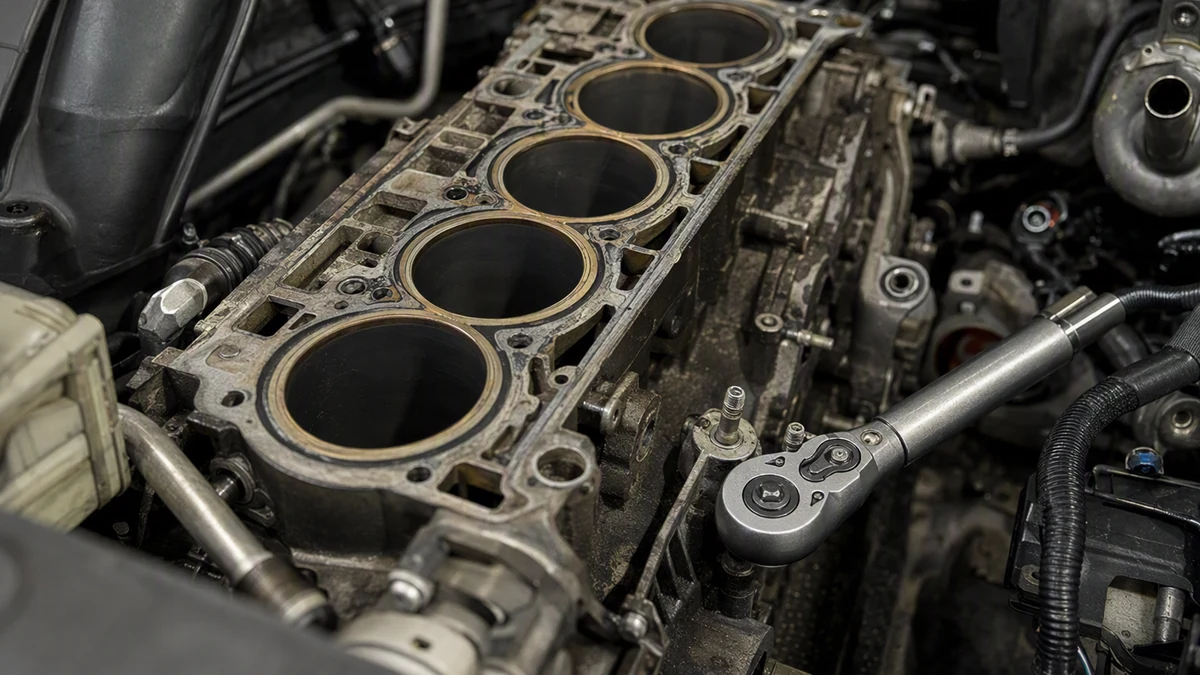
Overheating, white smoke and milky oil are the three signs that move a head gasket to the top of the suspect list. Here is how to tell them apart from cheaper problems, what the repair costs in the Orlando area, and why the number changes with every mile you keep driving.
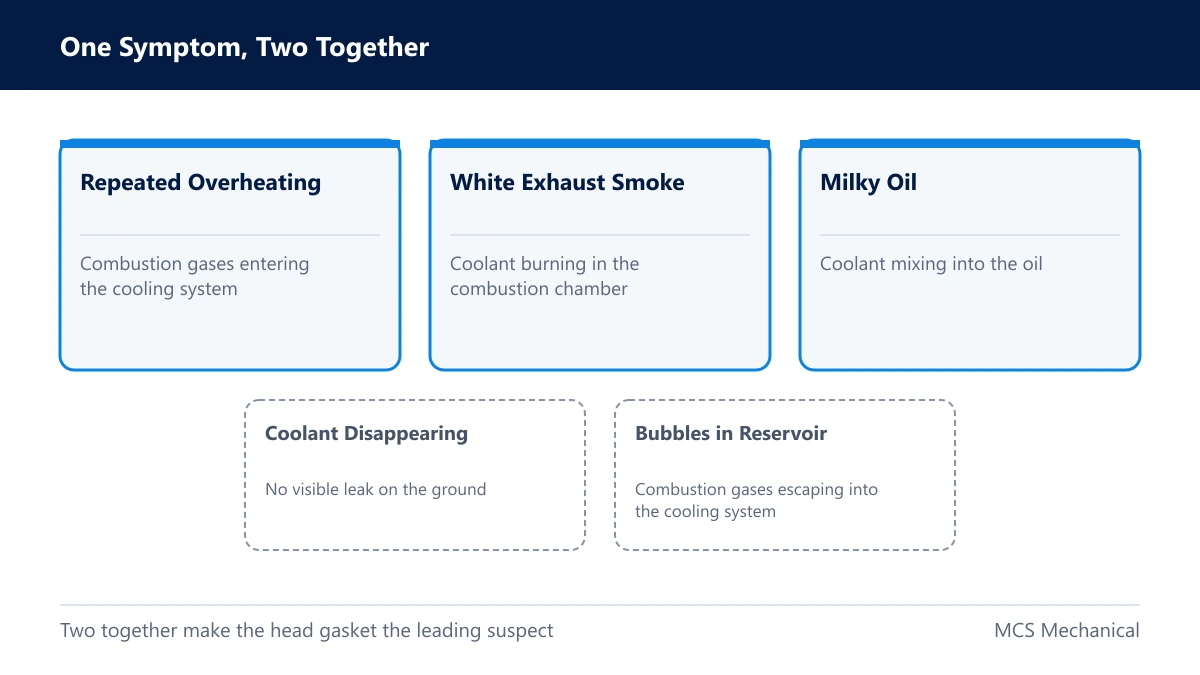
The most common blown head gasket symptoms are repeated overheating, white exhaust smoke and milky oil. A blown head gasket usually announces itself through three symptoms: repeated overheating, white smoke from the exhaust, and oil that looks milky on the dipstick. In the Orlando area, repairs commonly range from about $1,500 to $3,500 as of September 2026, and rise sharply if the cylinder head warps. Stop driving and get it diagnosed.
⚠️ Safety first. Never open a radiator cap or coolant reservoir on a hot engine. The system is pressurized and the coolant is well above boiling point — opening it can cause serious burns. Let the engine cool completely, and if the temperature gauge is in the red, stop driving and call for a tow.
Blown head gasket symptoms: the three signs that matter most
A head gasket seals the joint between the cylinder head and the engine block, keeping combustion pressure, coolant and oil in three separate places. When it fails, those three start mixing — and each combination produces its own symptom.
- Repeated overheating. The most common first sign. Combustion gases pushed into the cooling system create pressure and air pockets, so the system stops cooling properly. A car that overheats, gets “fixed,” and overheats again a week later is describing a head gasket, not a thermostat.
- White smoke from the exhaust. Coolant leaking into the combustion chamber is burned along with the fuel. The result is thick white smoke, often sweet-smelling, that continues after the engine is fully warm. Thin white vapor on a cool morning that disappears in two minutes is condensation and is normal.
- Milky oil. Coolant mixing into the oil produces a light brown, foamy residue — commonly described as looking like a milkshake — visible on the dipstick or under the oil filler cap.
Two more signs show up often enough to check: coolant disappearing with no visible leak on the ground, and bubbles in the coolant reservoir while the engine runs.
One symptom alone justifies a diagnosis. Two together make the head gasket the leading suspect. The reason to be careful is that each of these symptoms, on its own, also has a cheaper explanation — and that is exactly what a proper diagnosis separates.
Why Orlando’s heat puts head gaskets under extra stress
A head gasket fails from heat cycling — the repeated expansion and contraction of metal as the engine heats and cools. The cooling system’s margin is what keeps that within tolerance, and in Central Florida that margin is thinner for more of the year than almost anywhere else in the country.
According to NOAA’s U.S. Climate Normals for 1991–2020, measured at Orlando International Airport, Orlando averages 109.9 days per year with a maximum temperature of 90 °F (32 °C) or higher. The annual average temperature is 73.0 °F (22.8 °C). The load is concentrated: July averages 25.4 such days, August 24.4, June 20.0 and September 17.6.
| Month | Average days at or above 90 °F |
|---|---|
| May | 13.6 |
| June | 20.0 |
| July | 25.4 |
| August | 24.4 |
| September | 17.6 |
| Full year | 109.9 |
Source: NOAA/NCEI U.S. Climate Normals 1991–2020, station USW00012815 (Orlando International Airport).
Add stop-and-go traffic on I-4 or the 408, where airflow through the radiator drops to whatever the cooling fan can move, and a cooling system that is merely adequate in a milder climate runs without reserve here. That is why a marginal radiator, a weak fan or a slightly low coolant level tends to produce a real failure in Orlando rather than a warning.
The practical consequence: in Central Florida, a cooling system problem should be treated as urgent, not as something to watch. The head gasket is usually what the cooling system failure damages on its way through.
What a head gasket repair costs in the Orlando area
Head gasket replacement is expensive because of labor, not parts. The gasket itself is inexpensive; reaching it means removing the cylinder head, which on most modern engines is a substantial teardown.
| Item | Typical range |
|---|---|
| Common repair range | $1,500 – $3,500 |
| Full spread by vehicle and severity | $2,000 – $6,000 |
| Labor | 8 – 15 hours |
| Machine shop work to resurface the head | $200 – $500 |
| If the engine must be replaced instead | $4,000 – $10,000+ |
Ranges compiled from published 2026 repair-cost references (Synchrony, CoverageX, CRC Industries), accessed 16 September 2026. These are national figures, not Orlando-specific — there is no public, model-by-model repair price table for Florida. Your vehicle may differ, and MCS Mechanical provides a written estimate before any work begins; Florida law requires one for any repair expected to exceed $150.
What moves a specific vehicle within that range: whether the engine is transverse-mounted in a tight engine bay, whether the cylinder head can be resurfaced or must be replaced, whether the timing components have to come out, and parts availability for the model.
Why every mile changes the number
This is the part worth understanding before deciding to “drive it a little longer.”
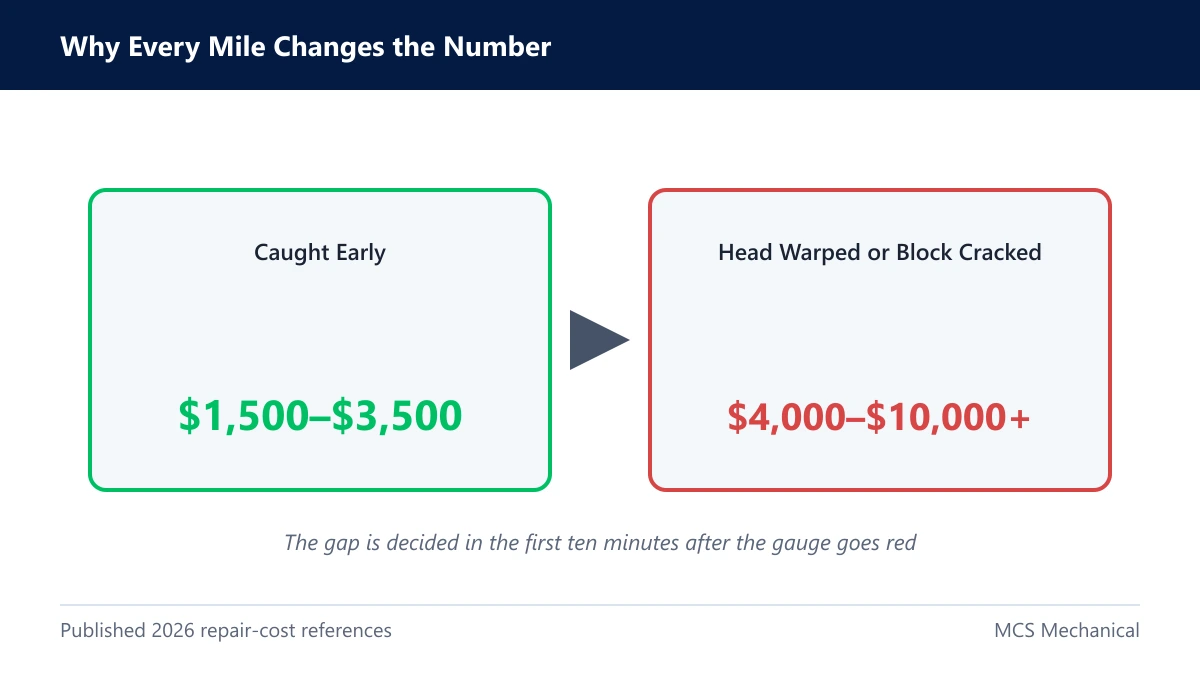
A head gasket failure does not stay a head gasket failure. Coolant in the combustion chamber and combustion gases in the cooling system mean the engine keeps overheating — and sustained overheating warps the cylinder head. A warped head can often be resurfaced at a machine shop for $200 to $500. Past a certain point it cannot, and must be replaced. Further still, the block itself can crack.
That is the escalation, in plain arithmetic:
- Caught early: roughly $1,500 – $3,500
- Head warped beyond resurfacing, or block cracked: engine replacement, $4,000 – $10,000+
The difference between those two outcomes is frequently a matter of how many miles were driven after the temperature gauge first went into the red. This is not a scare tactic — it is the reason the repair has a wide price range in the first place.
Will your extended warranty cover it?
Sometimes — and the deciding factor is usually not the gasket itself. A head gasket is a covered mechanical component under many vehicle service contracts. What gets claims denied is the finding that the failure resulted from overheating that continued after a warning.
Administrators generally distinguish between a part that failed and damage caused by driving a vehicle that was signalling a problem. That distinction is why two things matter enormously:
- Your maintenance record. Documented cooling system service — coolant changes on schedule, a radiator or thermostat replaced when it should have been — supports a mechanical failure finding.
- What you did when the gauge went up. Stopping and having the vehicle towed is a materially different fact pattern from driving another 40 miles.
Most contracts also require the shop to obtain authorization before the repair begins. On a job of this size, that step is not optional.
MCS Mechanical works with AGWS, AUL, Cars Protection Plus, NVP, Proguard, Protective, Secure One and Smart Autocare. We document the failure — including what the teardown shows about the cause — the way adjusters need to see it. The coverage decision is always the administrator’s.
Coverage language varies by administrator, and not every sample contract is public. Read your contract’s exclusions section, particularly anything about overheating, neglect or pre-existing conditions.
What this means for you
- The three leading symptoms of a blown head gasket are repeated overheating, persistent white exhaust smoke and milky oil. Two together make it the leading suspect.
- Orlando averages 109.9 days a year at or above 90 °F (NOAA Climate Normals 1991–2020, Orlando International Airport), which leaves cooling systems with less reserve than in most of the country.
- Common repair range is $1,500 to $3,500, with a full spread of $2,000 to $6,000 depending on vehicle and severity, driven mostly by 8 to 15 hours of labor.
- If the cylinder head warps beyond resurfacing or the block cracks, the job becomes an engine replacement at $4,000 to $10,000 or more.
- Extended warranty coverage often turns on whether the failure is judged mechanical or the result of continued driving after an overheating warning — documentation and your response to the gauge both matter.
- Florida law requires a written estimate for any repair expected to exceed $150 (Fla. Stat. §559.905).
Frequently asked questions
Can I still drive with a blown head gasket?
No. Driving with a failed head gasket is what turns a $1,500–$3,500 repair into a $4,000+ engine replacement, because continued overheating warps the cylinder head. If the temperature gauge reads high or you see white smoke, stop and arrange a tow. The cost of a tow is a fraction of the difference.
How long can I drive with it?
There is no safe mileage figure. Damage depends on how hot the engine gets and for how long, not on distance — an engine can be ruined in a few miles of stop-and-go traffic on I-4 in August. Treat the temperature gauge going into the red as a stop-now signal.
Do head gasket sealer products work?
They can occasionally slow a very small leak, but they do not repair a failed gasket and can clog passages in the radiator and heater core. They are a way to move a vehicle a short distance, not a repair. If a sealer is used, tell the shop — it changes what the diagnosis will find.
Why does my oil look like a milkshake?
That light brown, foamy appearance means coolant has mixed into the oil. A head gasket is the most common cause, though a cracked head or block and, on some vehicles, an oil cooler failure can produce it too. Do not keep driving — coolant in the oil destroys bearing surfaces quickly.
Is it worth fixing, or should I just replace the engine?
It depends on the vehicle’s value, its mileage and what the teardown finds. If the head resurfaces and the block is sound, repair is usually the better economic choice. If the head is beyond machining or the block is cracked, a replacement engine can cost less than an open-ended repair. The inspection decides.
Will my extended warranty cover a head gasket?
Often, if the failure is judged mechanical rather than the result of neglect or continued overheating. Documented cooling system maintenance strengthens the claim considerably. The repair must usually be authorized by the administrator before work begins. Coverage language varies by contract, and the decision is always the administrator’s.
How much does a diagnosis cost at MCS Mechanical?
It depends on the testing required — a block test for combustion gases in the coolant, a pressure test and a cooling system inspection take different amounts of time. Call (407) 853-0002 for the current diagnostic fee. Florida law requires a written estimate before any repair expected to exceed $150.
Do you have Spanish- or Portuguese-speaking staff?
Yes. Our team at MCS Mechanical speaks English, Spanish, Portuguese, French, Italian and Haitian Creole, so you can describe exactly what your car is doing in the language you are most comfortable with.
What to do this week
- Stop driving it if the temperature gauge goes into the red or you see continuous white smoke. Arrange a tow rather than one more trip.
- Check the oil when the engine is cold. Pull the dipstick and look under the oil filler cap. Photograph what you see — it is useful to the diagnosis and to a warranty claim.
- Look at the coolant reservoir — with the engine cold and the cap on. Note whether the level has dropped with no puddle under the car.
- Find your maintenance records, particularly anything about the cooling system. If you have an extended warranty, locate the contract.
- Get a diagnosis before authorizing any repair. A block test confirms or rules out combustion gases in the coolant in under an hour and is the difference between guessing and knowing.
If your car is overheating repeatedly, burning white smoke or showing milky oil, every additional mile is working against you. Bring your vehicle to MCS Mechanical at 2699 Old Winter Garden Rd, Unit B, Orlando, FL 32805, call (407) 853-0002, or visit our Engine Repair page to schedule a diagnosis. We’re open Monday through Friday, 8 AM to 6 PM, and Saturday, 8 AM to 2 PM — you can also reach us through our contact page or on WhatsApp.
Catching this early is the difference between a repair and a replacement, and that decision is usually made in the first ten minutes.
Sources and methodology
- NOAA / NCEI, U.S. Climate Normals 1991–2020, station USW00012815, Orlando International Airport — annual and monthly average number of days with maximum temperature ≥ 90 °F, annual average temperature. Accessed 16 September 2026.
- Synchrony — head gasket replacement cost reference, 2026. Accessed 16 September 2026.
- CoverageX — Head Gasket Repair Cost in 2026. Accessed 16 September 2026.
- CRC Industries — labor hours and machine shop resurfacing cost reference. Accessed 16 September 2026.
- CarTreatments — blown head gasket symptoms reference, 2026. Accessed 16 September 2026.
- Florida Statutes §559.905 — written estimate requirement, last amended ch. 2024-137. Accessed 16 September 2026.
Cost ranges in this article come from published national references and are not quotes for any specific vehicle. There is no public, model-by-model repair price table for Florida.
Cost ranges are estimates for the Orlando area as of September 2026 and vary by vehicle, parts availability and the extent of the failure. MCS Mechanical provides a written estimate before any repair begins. Coverage decisions are made solely by your warranty administrator; no repair shop can guarantee a claim outcome. This article is general information, not a diagnosis of your specific vehicle.
MCS Mechanical Service Team · Published 28 September 2026 · Updated 28 September 2026
Tags: engine-repair, diagnostics, repair-cost, florida-heat, orlando
Related reading