
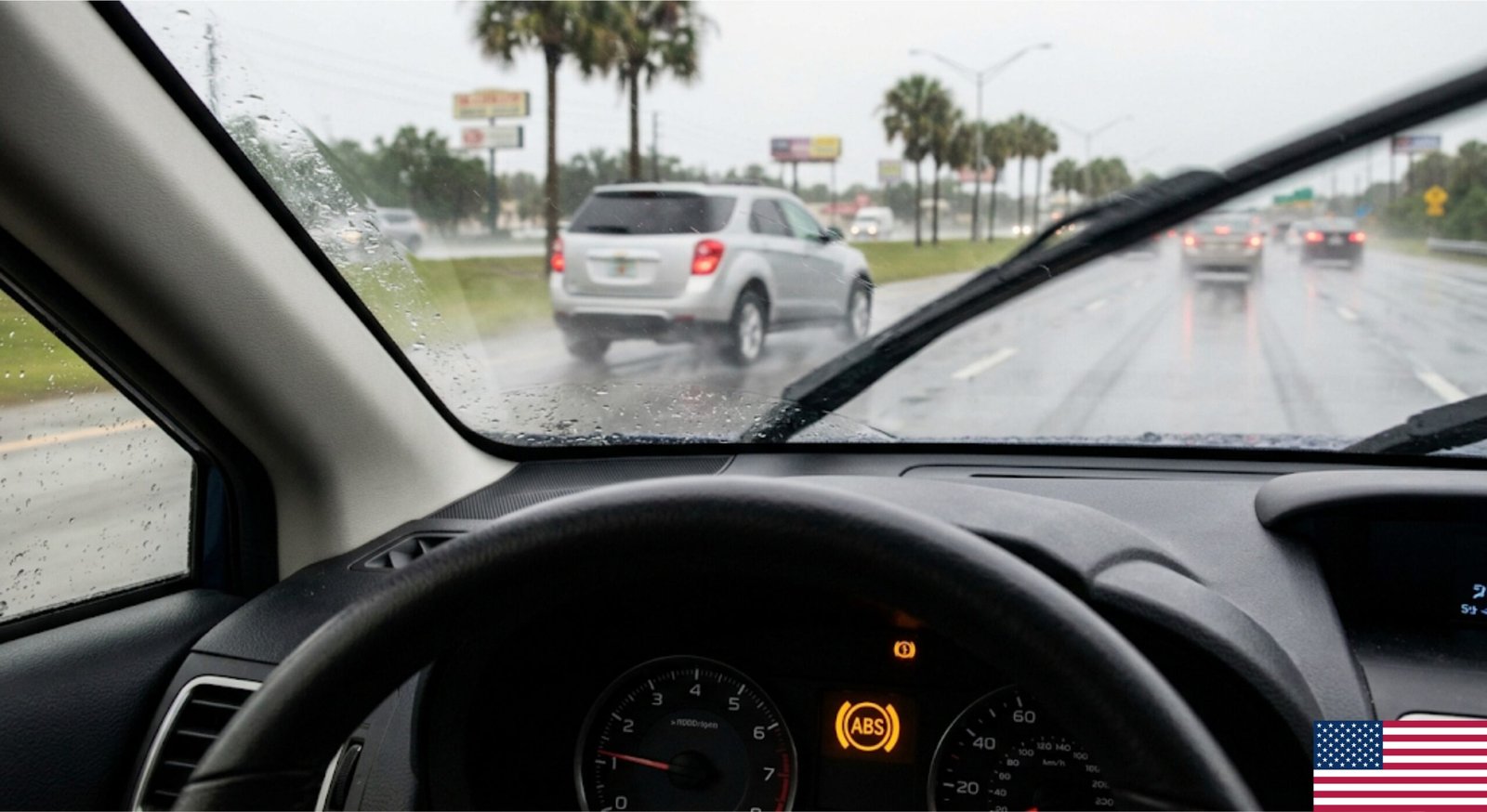
If the ABS light Orlando drivers dread just came on while you were driving around town, you are not alone. It is one of the most common warning lights we scan for at our shop on Old Winter Garden Rd, and it almost always points to a specific problem inside your anti-lock braking system rather than your everyday brakes. In this guide we explain what that ABS light actually means, the most common causes behind it, the real safety risk of ignoring it, and roughly what an ABS diagnostic and repair costs.
What Does the ABS Light Mean on Your Dashboard?
The ABS light is tied to your vehicle’s anti-lock braking system: a network of wheel speed sensors, a hydraulic pump, and a dedicated control module that keeps your wheels from locking up during hard braking. When everything is working, that system stays in the background and only kicks in during a panic stop or when a wheel starts to skid on a wet road. When the ABS light comes on, the module has detected a fault somewhere in that system and has disabled ABS function until the issue is fixed.
ABS Light Alone vs. ABS Light With Other Warning Lights
It matters a lot whether the ABS light is on by itself or alongside other dashboard lights. If only the ABS light is on, your regular hydraulic brakes are almost always still working normally — you can stop the car, you just do not have anti-lock protection. If the ABS light comes on together with the red brake warning light, treat it as more urgent, since that combination can point to low brake fluid, a hydraulic issue, or a problem that affects your everyday braking, not just the anti-lock feature. In that case it is worth having both systems checked together — our team can look at ABS-specific and brake-hydraulic issues in the same visit; see our brake repair services in Orlando for more on that side of things. If the ABS light comes on with the traction control or stability control light, that is usually not a coincidence — those systems rely on the same wheel speed sensors as ABS, so one bad sensor often lights up all three at once.
Common Causes of the ABS Light Orlando Drivers Deal With
In our experience working on cars, trucks, and SUVs across Orlando, a handful of causes account for the vast majority of ABS light complaints:
- A faulty wheel speed sensor (by far the most common cause)
- Low brake fluid level
- A failing ABS pump or control module
- A blown ABS fuse
- Corroded wiring or connectors at the wheel sensors
Faulty Wheel Speed Sensor — the Most Common Culprit
Each wheel has its own speed sensor that tells the ABS module how fast that wheel is spinning. If one sensor gets dirty, damaged by road debris, or simply fails, the module cannot get an accurate reading and shuts the system down as a safety precaution. The good news is that a wheel speed sensor issue is usually the least expensive scenario to fix, since it typically only requires cleaning, repairing the wiring, or replacing a single sensor rather than the entire ABS module.
Florida Humidity and Corrosion at the Wheel Sensors
Florida’s humidity and frequent exposure to standing water on the road take a toll on the connectors and wiring near the wheel sensors, especially on vehicles that spend time near coastal areas where salt air speeds up corrosion. Over time, moisture works its way into the sensor connector, causing a weak or intermittent signal that trips the ABS light. This is one of the reasons ABS sensor issues show up more often on Central Florida vehicles than in drier climates, and it is also why a visual inspection alone is not always enough to catch the problem — sometimes the connection only fails under certain conditions, which is exactly what a proper scan can help pinpoint.
Is It Safe to Drive With the ABS Light On?
Here is the honest answer: in most cases, yes, you can still drive and your normal braking will work. The ABS light on its own does not mean your brakes have failed. What it does mean is that you have lost the anti-lock protection that keeps your wheels from locking up during a hard or panic stop. Under normal, dry, everyday driving, you may never notice a difference. But Orlando sees frequent afternoon thunderstorms, especially from June through September, and wet pavement is exactly when ABS matters most. Without it working, a hard stop on a rain-slicked road can cause your wheels to lock, which leads to skidding and a real loss of steering control, right when you need it most. That is the real-world risk of leaving an ABS light unaddressed, and it is why we recommend getting it looked at sooner rather than later, especially before rainy season driving or a road trip.
Common ABS Light Causes, Cost Tier, and Urgency
Every vehicle and situation is a little different, but this table gives you a general sense of what we typically see, ordered from least to most involved.
| Cause | Likely Cost Tier | Urgency |
|---|---|---|
| Faulty wheel speed sensor | Low | Medium — fix soon, avoid hard stops on wet roads |
| Low brake fluid level | Low | High — check fluid and inspect for leaks right away |
| Corroded wiring or connector | Low to Medium | Medium — often intermittent, can worsen over time |
| Blown ABS fuse | Low | Medium — simple fix, but recheck for the underlying cause |
| Failing ABS pump or hydraulic unit | Medium to High | Medium to High — schedule a diagnostic soon |
| Failing ABS control module | High | Medium to High — needs a proper scan to confirm before replacing |
Why the ABS Light Needs a Real Electronic Diagnostic Scan
One of the most important things to understand about the ABS light is that it cannot be diagnosed the same way as a check engine light. Your engine’s OBD-II codes and your ABS module’s fault codes live on separate systems inside the car, and a basic, generic code reader — even a decent one — often cannot communicate with the ABS module at all. That means it may read ‘no codes found’ on the engine side while completely missing the actual ABS fault. To get an accurate answer, a technician needs a scan tool capable of reading ABS-specific fault codes and, in many cases, checking live sensor data while the wheels are turning. That is exactly what our electronic diagnostics service in Orlando is built for — pulling the manufacturer-specific ABS codes, checking wheel speed sensor signals in real time, and confirming exactly which component is causing the fault before any parts are replaced. Skipping this step is how people end up paying to replace an ABS module that was never actually the problem.
How Much Does ABS Diagnostic and Repair Cost in Orlando?
We would rather give you an honest range than a number that does not hold up once we look at your specific vehicle. In general, a wheel speed sensor replacement tends to be the least expensive scenario, since it is a single part with straightforward labor. Wiring or connector repairs fall in a similar low-to-moderate range, depending on how much of the harness needs attention. A failing ABS pump or hydraulic control unit sits in the medium-to-high range because of the part cost and labor involved. A full ABS control module replacement is typically the most expensive outcome, since the module often needs to be programmed to your specific vehicle after installation. The best way to know where your car falls is a proper diagnostic scan rather than guessing based on symptoms alone. Call us at (407) 853-0002 and we can walk you through next steps, or get an accurate diagnosis first through our electronic diagnostics service before committing to any repair. Any repair work we perform is backed by our 24-month parts and labor warranty, so you are covered if anything related to that repair comes up again.
Frequently Asked Questions
Can I still drive with the ABS light on?
In most cases yes, your normal brakes will still work and you can drive. But you will not have anti-lock protection during a hard stop, which matters most on wet roads or in an emergency stop situation. We recommend having it diagnosed as soon as you reasonably can rather than waiting.
Will the ABS light turn itself off?
Sometimes an ABS light triggered by a loose connector or a momentary glitch can go off after a drive cycle or two, but that does not mean the underlying issue is fixed. If the light returns, or if it stays on, the fault is still stored in the module and should be scanned.
Does low brake fluid trigger the ABS light too?
Yes, in many vehicles a low brake fluid level can trigger both the brake warning light and the ABS light at the same time, since the ABS module monitors fluid level as part of overall brake system health. If you see both lights together, check your fluid level and have the system inspected for a possible leak.
Can a blown fuse cause the ABS light to come on?
Yes. A blown ABS fuse will cut power to the module and immediately trigger the warning light. It is a relatively inexpensive fix, but it is worth finding out why the fuse blew in the first place, since a short in the wiring can cause it to happen again.
Why does my ABS light seem to come on mostly when it rains in Orlando?
This is a pattern we see often, and it usually points to a corroded or marginal wheel speed sensor connector. Moisture getting into a weak connection can cause an intermittent signal loss that only shows up in wet conditions, which is also exactly the situation where you most need ABS to be working.
Is an ABS diagnostic the same as a regular check engine scan?
No. The ABS module uses its own set of fault codes separate from your engine’s OBD-II codes, and many basic code readers cannot access it at all. A proper ABS diagnostic requires a scan tool built to communicate with the ABS module specifically.
How long does an ABS diagnostic scan take?
A typical ABS diagnostic scan can often be completed in under an hour, though the exact time depends on the vehicle and whether the technician needs to test wheel speed sensor signals while road testing. We will always explain what we find before moving forward with any repair.
Get Your ABS Light Diagnosed at MCS Mechanical
An ABS light is not something to put off, especially with Florida’s rainy season bringing sudden downpours to Orlando roads. Our TechNet certified technicians use proper electronic diagnostic equipment to read ABS-specific fault codes, confirm the real cause, and give you a clear, honest repair plan — not a guess. All repair work is backed by our 24-month parts and labor warranty, and our team speaks English, Portuguese, and Spanish. Call us today at (407) 853-0002, stop by 2699 Old Winter Garden Rd, Orlando, FL 32805, or contact us online to schedule your ABS diagnostic before that warning light turns into a bigger safety issue. We are open Monday through Friday from 8am to 6pm and Saturday from 8am to 2pm.