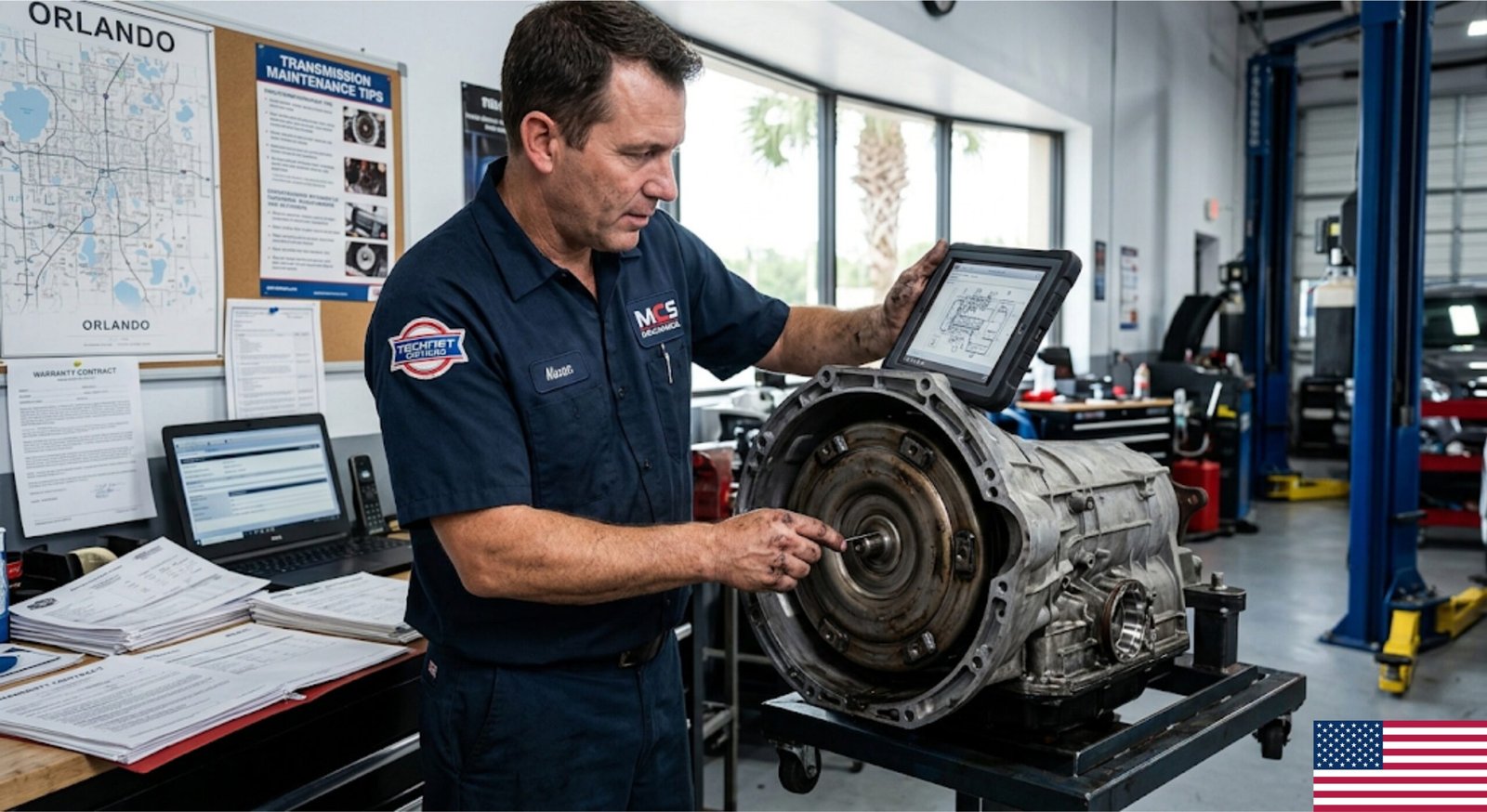
If your automatic transmission is slipping, hesitating on shifts, or making a whining or grinding noise somewhere on I-4 or Colonial Drive in Orlando, you are probably asking the same question we hear every week: does extended warranty cover automatic transmission repair? The honest answer is that it depends almost entirely on why the transmission failed and how well that cause gets documented before any repair starts. Transmission claims are some of the largest dollar amounts an extended warranty company ever pays out, and that alone makes them the claims adjusters scrutinize the hardest. At MCS Mechanical, a TechNet Certified shop at 2699 Old Winter Garden Rd in Orlando, FL, we build transmission warranty claim files every week for customers holding contracts with AGWS, Protective, Secure One, and most of the other major extended warranty providers. Call us at (407) 853-0002 before you authorize any transmission work, and we will walk you through exactly what your policy covers.
Why Transmission Claims Face More Scrutiny Than Almost Any Other Warranty Repair
A full transmission rebuild in Orlando typically runs between $3,000 and $6,500, and a full replacement can run higher depending on the vehicle. That makes a transmission claim one of the single most expensive line items an extended warranty company will ever approve, right alongside engine claims. Because the payout is so large, adjusters do not approve transmission claims on a phone call and a hunch. They request maintenance records going back years, they review diagnostic scan data, and on higher-dollar claims they sometimes send an independent inspector to physically confirm the failure before authorizing a rebuild or replacement. A transmission claim with thin documentation is far more likely to get delayed, sent back for more information, or denied outright, even when the underlying failure is a covered internal defect.
What’s Typically Covered Under an Extended Warranty for Transmission Repair in Orlando
Most extended warranty contracts, including the major providers we work with in Orlando, cover internal transmission failures caused by normal wear or a manufacturing defect, as long as the vehicle was maintained according to the manufacturer’s schedule. Coverage decisions come down to two questions: was the failed part actually an internal, covered component, and can the failure be tied to wear or a defect rather than neglect or abuse.
Internal Component Failures That Usually Qualify
- Worn clutch packs that have reached the end of their normal service life
- Failed solenoids inside the valve body or transmission case
- Torque converter failure, including shuddering, overheating, or lockup clutch failure
- Valve body defects, including manufacturing-related pressure or shift-timing faults
- Complete internal failure requiring a rebuild or replacement, when the root cause is a covered component
Documentation That Makes Coverage Approval More Likely
- Diagnostic trouble codes and scan data that pinpoint the exact fault
- Fluid condition, color, and level recorded at the time of inspection
- A complete maintenance history showing fluid services were performed on schedule
- Teardown photos, when a rebuild is required, showing the specific failed component
What Typically Gets Denied and Why
Insurers deny far more transmission claims for maintenance and usage reasons than for any dispute over whether a part is technically covered. In our experience handling claims across AGWS, AUL, Cars Protection Plus, NVP, Proguard, Protective, Secure One, and Smart Autocare contracts, the denials almost always trace back to one of a small handful of patterns.
Fluid Service and Maintenance-Related Denials
Skipped or overdue fluid services are the single most common reason a transmission claim gets denied. If the fluid was never changed on the interval the manufacturer specifies, or if the fluid is dark, burnt, and clearly overdue at the time of inspection, an adjuster has grounds to argue the failure resulted from lack of maintenance rather than a covered defect. This is especially true for CVT transmissions, which are far less tolerant of the wrong fluid type than a traditional automatic. Using a generic or incorrect ATF in a CVT is one of the fastest ways to cause internal damage, and it is also one of the fastest ways to get a claim denied, because most contracts specifically exclude damage caused by using the wrong fluid for that transmission.
Towing, Modifications, and Ignored Warning Signs
Towing beyond a vehicle’s rated capacity puts sustained heat and load on a transmission that it was never engineered to handle, and most extended warranty contracts exclude damage tied to overloading. Aftermarket tuning or performance modifications that increase torque output create a similar problem: the transmission is now working under stress levels the manufacturer never accounted for, and insurers routinely deny claims once a tune or modification shows up in the vehicle’s history. The third pattern we see constantly is a transmission that was already slipping or hesitating for weeks or months before the owner brought it in. If a pre-existing symptom was ignored and the transmission got worse as a result, an adjuster can classify the eventual failure as a pre-existing condition rather than a sudden covered failure, and deny the claim on that basis.
Likely Covered vs Likely Denied: Transmission Scenarios in Orlando
Every claim is judged on its own facts and the specific language in your contract, but these are the patterns we see most often when we submit transmission claims on behalf of Orlando drivers.
| Transmission Scenario | Likely Outcome | Why |
|---|---|---|
| Torque converter shudder with fluid services performed on schedule | Likely Covered | Internal wear on a covered component with maintenance proof |
| Valve body solenoid failure causing harsh or delayed shifts | Likely Covered | Internal component failure tied to wear or a manufacturing defect |
| Internal clutch pack wear with complete maintenance records | Likely Covered | Normal wear-and-tear failure supported by documentation |
| Burnt, dark transmission fluid that was never changed on schedule | Likely Denied | Attributed to neglected maintenance rather than a covered defect |
| Wrong fluid type used in a CVT during a prior service | Likely Denied | Classified as improper maintenance, not mechanical failure |
| Transmission damage after towing above the vehicle’s rated capacity | Likely Denied | Treated as abuse or overloading, excluded under most contracts |
| Complete failure after months of ignored slipping or hesitation | Likely Denied | Classified as a worsened pre-existing condition |
| Torque converter failure on a vehicle with aftermarket tuning | Likely Denied | Modification considered to have increased stress beyond factory design |
How MCS Mechanical Builds a Transmission Claim File That Withstands Adjuster Scrutiny
Because transmission claims get more scrutiny than almost anything else an extended warranty pays for, we build the claim file the same way an adjuster would want to review it, before we ever call the insurer.
- Fluid condition documentation – color, smell, and fill level, photographed at intake before any work begins
- Diagnostic scan data showing the specific fault code, freeze-frame data, and live data confirming the failure
- A maintenance record cross-check against the manufacturer’s recommended service intervals
- Teardown photographs, when a rebuild is needed, documenting the failed component before repair
If your contract is with one of the providers on our list, including AGWS, Protective, or Secure One, we can usually tell you within one visit whether your specific failure is likely to qualify for coverage. You can see our full transmission repair services in Orlando and browse all of the insurers we work with on our extended warranty page. And if the claim is approved but the transmission still needs work beyond what the warranty covers, every repair we perform is backed by our own 24-month parts and labor warranty.
What To Do If Your Transmission Warranty Claim Gets Denied
A denial is not always the final word. Start by asking the insurer for the specific written reason for the denial, not just a general statement that the repair was not covered. Many transmission denials trace back to a technical or documentation issue rather than an actual exclusion in the contract, which is exactly what we cover in our guide to five technical mistakes that get warranty claims denied. If you believe your claim was denied unfairly or the insurer is not honoring the contract terms, you can also file a complaint with the Consumer Financial Protection Bureau, which tracks complaints against vehicle service contract providers.
Frequently Asked Questions About Extended Warranty Transmission Coverage in Orlando
Does an extended warranty cover a full transmission rebuild or replacement in Orlando?
Yes, if the failure is traced to an internal component such as a torque converter, valve body, solenoid, or clutch pack, and the failure is tied to normal wear or a manufacturing defect rather than neglect, towing abuse, or modifications. The vehicle also needs to have been maintained according to the schedule in your contract.
Will my warranty deny a claim if I missed one fluid change?
Missing a single scheduled fluid service does not automatically void coverage, but it does give the adjuster grounds to ask more questions. If the fluid is severely degraded or clearly overdue by a wide margin at the time of failure, that gap becomes much harder to defend. Keeping fluid services on schedule, even at an independent shop like ours, protects your coverage.
Why does fluid type matter so much for CVT transmissions?
CVT transmissions use a specific fluid formulated for the belt-and-pulley or chain design inside the unit, and substituting a generic ATF can cause slipping, overheating, and internal wear within a relatively short time. Because the damage pattern from wrong fluid is well documented, most insurers deny CVT claims quickly once they confirm the wrong fluid was used.
How long does an extended warranty transmission claim take to get approved in Orlando?
Straightforward claims with clean maintenance records and clear diagnostic data can be approved in a day or two. Claims that require an independent inspector, or where the maintenance history is incomplete, can take a week or longer. Submitting a complete claim file up front is the single biggest factor in how fast a transmission claim moves.
Can MCS Mechanical work directly with my extended warranty company?
Yes. We regularly work directly with AGWS, AUL, Cars Protection Plus, NVP, Proguard, Protective, Secure One, and Smart Autocare, submitting diagnostics, photos, and maintenance documentation directly to the adjuster so you are not stuck relaying information back and forth.
Does towing a trailer void my transmission warranty coverage?
Towing itself does not void coverage, but towing beyond the vehicle’s rated capacity does give the insurer grounds to deny a resulting transmission claim, since most contracts specifically exclude damage from overloading.
What if my transmission claim was already denied?
Request the written denial reason, have us review the diagnostic and maintenance documentation against that reason, and check it against the common technical mistakes we outline in our denial guide. In some cases a properly documented appeal with corrected or additional evidence gets a denial overturned.
Bring Your Vehicle and Warranty Paperwork to MCS Mechanical Before You Authorize Transmission Work
Transmission repairs are expensive enough that it is worth getting the claim right before a single bolt gets turned. Bring your vehicle and your extended warranty paperwork to MCS Mechanical at 2699 Old Winter Garden Rd, Orlando, FL 32805, and our TechNet Certified technicians will run the diagnostics, document the fluid condition, and tell you honestly whether your failure looks like a covered repair before you authorize anything. We speak English, Portuguese, and Spanish, and we’re open Monday through Friday from 8am to 6pm and Saturday from 8am to 2pm. Call us at (407) 853-0002 or contact us online to schedule your diagnostic before your warranty claim goes in.