Catalytic converter failure and catalytic converter theft can both trigger a P0420 code in Orlando — but they call for completely different repairs, costs, and next steps, including what Florida’s 2023 theft law means for you.
A P0420 code means your vehicle’s computer found the catalytic converter working below an acceptable threshold — usually because of an unresolved misfire, oil leak, or coolant leak, not because the part was stolen. If yours is physically gone, Florida’s 2023 theft law applies. Replacement in the Orlando area commonly runs $1,000 to $3,500 as of October 2026.
What a P0420 catalytic converter code actually measures
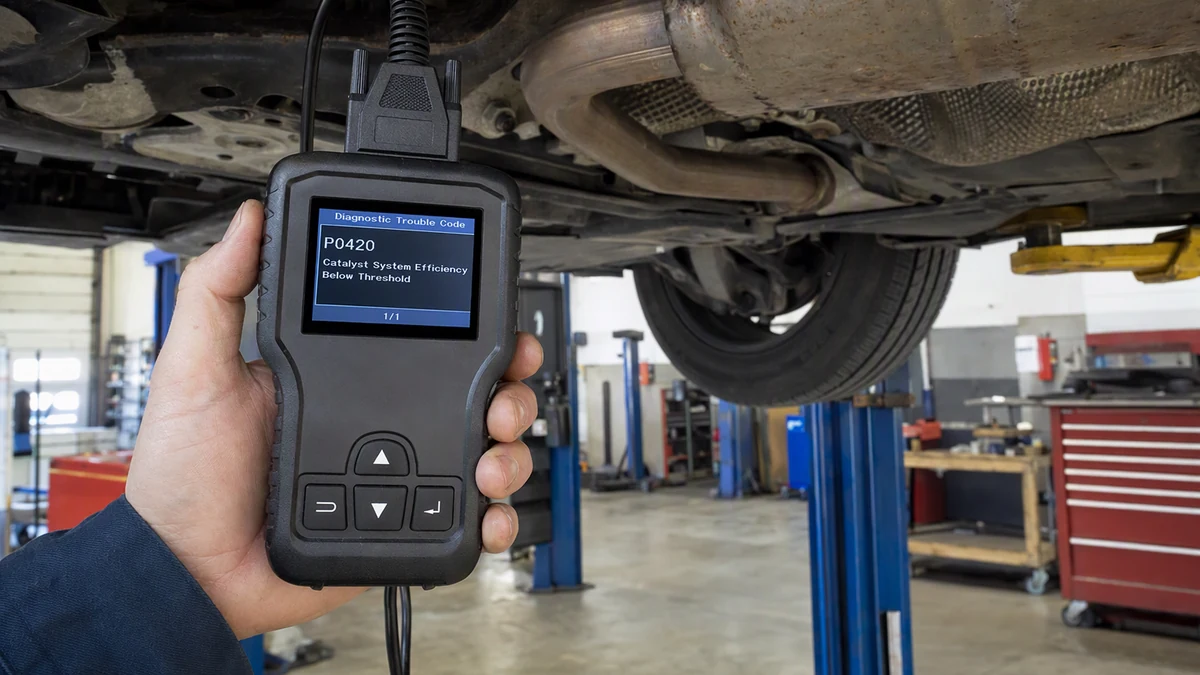
A P0420 catalytic converter code means your engine computer, the powertrain control module (PCM) — the computer that manages engine and emissions systems — found the catalytic converter’s efficiency below an acceptable threshold. The PCM reaches that conclusion by comparing two oxygen sensors: one mounted before the catalytic converter and one after it, following the standard OBD-II diagnostic logic documented by automotive diagnostic reference Samarins.com.
On a healthy converter, the front sensor’s signal swings back and forth constantly as the engine runs, while the rear sensor stays comparatively steady — proof the converter is still storing and releasing oxygen the way it should. When the rear sensor starts mirroring the front sensor too closely, the PCM concludes the converter’s oxygen storage capacity has dropped, and it sets the P0420 code.
P0420 is the Bank 1 version of this code. On engines with two exhaust banks, the same fault on the second bank sets P0430 instead. Neither code names what damaged the converter — that takes a scan tool reading live oxygen sensor data, not just the stored code number.

The real root causes behind most P0420 codes
A P0420 code frequently names a catalytic converter that is failing because of something else in the engine, not because it simply wore out on its own. According to Samarins.com’s technical diagnostic reference, the most common root causes are:
- Misfire. An engine misfire — when a cylinder fails to burn its fuel completely — sends unburned fuel into the exhaust, where it overheats and damages the catalyst inside the converter.
- Oil leak into the exhaust. Worn piston rings, a failing PCV (positive crankcase ventilation) system, or a leaking turbocharger lets oil reach the exhaust stream; the converter tries to burn off that oil and overheats.
- Coolant leak. A failing head gasket or a cracked cylinder head can send coolant into the combustion chamber, where it travels downstream and damages the converter.
- Exhaust leaks. A leak upstream of either oxygen sensor skews both readings and should be repaired before the converter itself is tested at all.
A proper diagnosis checks for an active misfire, an oil leak, and a coolant leak before anyone recommends converter replacement. Replacing the converter without fixing the underlying problem almost always means the new part fails again, on the exact same drive on I-4 or the 408 that damaged the first one.
Converter failure vs. converter theft in Orlando
A P0420 code and a stolen catalytic converter can look similar from the driver’s seat — both start with something wrong underneath the car — but they are different problems with different costs and different first steps. The table below separates the three scenarios that most often bring Orlando drivers in with this code.
| Scenario | What’s really happening | Typical cost range (Orlando, Oct. 2026) | Urgency |
|---|---|---|---|
| Converter worn from age or mileage | Natural catalyst contamination or degradation over time; steady check engine light, few other symptoms | $1,000 – $3,500+ for the converter alone | Moderate — schedule a diagnosis soon |
| Converter physically stolen | Cut out from underneath the vehicle; loud roaring or rattling exhaust noise from the moment the engine starts, visible gap under the car | $1,000 – $3,500+ for a compliant replacement, plus any exhaust pipe work, separate from a police report or insurance claim | High — file a police report and get a written estimate before regular driving |
| P0420 triggered by an unrelated misfire or leak | A misfire, oil leak, or coolant leak is overheating or contaminating a converter that may still be sound | Root-cause repair cost varies widely — from a set of spark plugs to a head gasket job — separate from converter cost | High — a flashing check engine light means stop driving now |
Ranges reflect published October 2026 repair-cost data for the Orlando area; costs vary by vehicle, parts availability and the extent of the failure. MCS Mechanical provides a written estimate before any repair begins.
How to tell if your catalytic converter was stolen
A stolen catalytic converter usually announces itself the moment you start the engine: a loud, metallic roar or rattle, noticeably louder than a normal exhaust note. With the engine off and the vehicle parked on level ground, look underneath — a missing converter leaves a visible gap or a section of hanging, freshly cut pipe between the engine and the muffler. The check engine light may or may not come on, since not every vehicle reacts the same way to a missing converter and its sensors.
What it costs to fix a P0420 code in Orlando
Catalytic converter replacement alone commonly costs $1,000 to $3,500 or more as of October 2026, according to published repair-cost data from CoverageX. Labor typically runs $150 to $300 per hour for 1 to 3 hours on an accessible converter, climbing toward $500 to $1,000 in labor alone when half the exhaust system has to come off first. Parts range from about $400–$1,200 for a quality aftermarket converter to $800–$2,000 or more for an OEM (original equipment manufacturer) unit, per the same source.
If a misfire, oil leak, or coolant leak caused the code, that repair is priced separately from the converter itself — the total can range from the cost of a set of spark plugs to a full head gasket job, depending on what the diagnosis finds. These are national reference figures, not a quote for any specific vehicle; there is no public, model-by-model repair price list for Florida. MCS Mechanical provides a written estimate before any repair begins, as Florida law requires for any repair expected to exceed $150.
If your converter was stolen, standard liability auto insurance typically will not cover the replacement; comprehensive coverage might, according to CoverageX, so it is worth checking your policy before assuming the repair is entirely out of pocket.
Florida’s 2023 catalytic converter theft law, explained
Florida’s Catalytic Converter Antitheft Act, created by Chapter 2023-114, Laws of Florida (originally CS/CS/SB 306), took effect July 1, 2023. The law targets the market for stolen converters, not only the act of theft itself, through a new criminal statute, Fla. Stat. §860.142.
Under §860.142, knowingly possessing a detached catalytic converter without proof of ownership is a third-degree felony, unless the person is a registered secondary metals recycler, a licensed salvage motor vehicle dealer, or otherwise exempt under Fla. Stat. §538.22. Possessing two or more detached converters without a satisfactory explanation creates a legal inference that the person knew or should have known they were stolen — a provision aimed at scrap buyers, not at drivers who had a converter stolen from their own vehicle.
The same law amended Fla. Stat. §538.26 to require every secondary metals recycler to hold a purchased detached catalytic converter for 10 business days before processing it or removing it from their place of business — a cooling-off period meant to give police time to match a recovered part to a theft report.
Florida lawmakers acted after catalytic converter theft reports in the state jumped from 24 in 2019 to 137 in 2020 and 631 in 2021, according to National Insurance Crime Bureau (NICB) data cited in the Florida Legislature’s own 2023 analysis of the bill — an analysis that also notes the real total is likely higher, since it counts only thefts reported to NICB. That same legislative analysis cites a Jacksonville television investigation that found Jacksonville police alone logged roughly 900 catalytic converter thefts in just the first eleven months of 2022.
There is a federal layer as well. Under the federal Clean Air Act, removing a catalytic converter without installing a compliant replacement is a form of emissions tampering. The EPA’s November 2020 Tampering Policy sets out the emissions testing and permanent labeling a replacement after-treatment system must meet to be legal. In practical terms, after a theft, the replacement needs to be a real, compliant catalytic converter — not an uncertified “universal” part or a straight pipe — to avoid creating a second, separate problem.
What this means for you
- P0420 means “Catalyst System Efficiency Below Threshold,” detected by comparing the pre- and post-catalyst oxygen sensors, per standard OBD-II diagnostic logic.
- Misfires, oil leaks, coolant leaks, and exhaust leaks are the most common root causes damaging a converter that may otherwise be sound (Samarins.com).
- Catalytic converter replacement alone commonly costs $1,000 to $3,500 or more as of October 2026 (CoverageX).
- Florida catalytic converter theft reports rose from 24 in 2019 to 137 in 2020 and 631 in 2021, per NICB data cited in the Florida Legislature’s 2023 bill analysis.
- Florida’s Catalytic Converter Antitheft Act (Ch. 2023-114), effective July 1, 2023, made possessing a detached, unexplained converter a third-degree felony under Fla. Stat. §860.142.
- Fla. Stat. §538.26 now requires secondary metals recyclers to hold a purchased detached converter for 10 business days before processing it.
- Under the federal Clean Air Act, a replacement converter must meet EPA emissions-testing and labeling requirements — an uncertified part is a separate problem from the original code.
Frequently asked questions
What does the P0420 code mean?
P0420 means “Catalyst System Efficiency Below Threshold.” Your vehicle’s computer compares the oxygen sensor before the catalytic converter with the one after it; if the two readings look too similar, the converter isn’t cleaning exhaust well enough, per standard OBD-II diagnostic logic. The code names the symptom, not the cause — a diagnosis does.
Can I drive with a P0420 code?
It depends on whether the check engine light is steady or flashing. A steady light usually allows short-term driving to a diagnosis appointment. A flashing light signals an active misfire sending unburned fuel into the converter, which can destroy it within minutes — stop driving and arrange a tow instead.
How much does it cost to fix a P0420 code?
Catalytic converter replacement alone commonly runs $1,000 to $3,500 or more as of October 2026, depending on OEM versus aftermarket parts and how accessible the converter is, according to published repair-cost data. If a misfire, oil leak, or coolant leak caused it, that repair is priced separately. MCS Mechanical provides a written estimate before any work begins.
Is P0420 always the catalytic converter?
No. The code flags the converter’s performance, but the part itself is frequently a victim rather than the cause. Misfires, oil leaks, coolant leaks, and exhaust leaks commonly damage a converter that was otherwise fine. A proper diagnosis checks those systems before anyone replaces the converter itself.
How do I know if my catalytic converter was stolen?
The most common sign is a sudden, loud roaring or rattling exhaust noise starting the moment you turn the key — often louder than the engine itself. With the car parked and off, look underneath for a visible gap or a hanging, freshly cut pipe between the engine and muffler. A P0420 code may or may not also appear.
Is catalytic converter theft illegal in Florida?
Yes. Florida’s Catalytic Converter Antitheft Act, effective July 1, 2023, makes possessing a detached catalytic converter without proof of ownership a third-degree felony under Fla. Stat. §860.142, unless the person is a registered secondary metals recycler or licensed salvage dealer. Report a theft to police right away for your own case and any insurance claim.
How much does a diagnosis cost at MCS Mechanical?
Diagnostic cost depends on the system involved and how much testing the fault requires — reading live oxygen sensor data is a different job than tracing a misfire or an oil leak. Call us at (407) 853-0002 for the current diagnostic fee, and note that Florida law requires a written estimate before any repair expected to exceed $150.
Do you have Spanish- or Portuguese-speaking staff?
Yes. Our team at MCS Mechanical speaks English, Spanish, Portuguese, French, Italian and Haitian Creole, so you can describe exactly what your car is doing — or exactly what you found missing underneath it — in the language you’re most comfortable with.
What to do this week
- Check whether the check engine light is steady or flashing, and note which one it is — a flashing light means stop driving and arrange a tow.
- Look underneath the vehicle with the engine off and the car parked on level ground, checking for a visible gap or a hanging, freshly cut pipe between the engine and the muffler.
- Write down everything the car is doing — noise, smell, when the light came on, any recent repairs. It helps the diagnosis, and if the converter was stolen, it helps the police report.
- If you suspect theft, file a police report before anything else. Insurers and the court system both rely on a report filed close to when you discovered the loss.
- Ask for a scan tool reading, not just the code number. A shop needs the live oxygen sensor data behind the P0420 code to find the real cause, not just the three characters themselves.
Whether your P0420 code points to a tired converter, an unresolved misfire, or an empty space where the converter used to be, the next step is the same: get it read properly before anyone replaces a part. Bring your vehicle to MCS Mechanical at 2699 Old Winter Garden Rd, Unit B, Orlando, FL 32805, call (407) 853-0002, or visit our Electronic Diagnostics page to schedule a diagnosis. We’re open Monday through Friday, 8 AM to 6 PM, and Saturday, 8 AM to 2 PM — you can also reach us through our contact page or on WhatsApp. Either way, the code is a starting point, not a verdict — the scan tool decides what happens next.
Sources and methodology
- EPA Tampering Policy: The EPA Enforcement Policy on Vehicle and Engine Tampering and Aftermarket Defeat Devices under the Clean Air Act — U.S. EPA, issued 23 November 2020. Accessed 15 October 2026.
- Laws of Florida, Chapter 2023-114 (CS/CS/SB 306) — “Catalytic Converter Antitheft Act,” signed 24 May 2023, effective 1 July 2023. Accessed 15 October 2026.
- Florida Statutes §860.142, Catalytic Converter Antitheft Act — Florida Legislature. Accessed 15 October 2026.
- Florida Statutes §538.26, Certain acts and practices prohibited — Florida Legislature. Accessed 15 October 2026.
- Florida Statutes §559.905, Written motor vehicle repair estimate and disclosure statement required — Florida Legislature. Accessed 15 October 2026.
- Florida Office of Economic and Demographic Research — analysis of CS/HB 185 (2023), Criminal Justice Impact Conference — cites National Insurance Crime Bureau (NICB) theft data and a News4Jax investigation. Accessed 15 October 2026.
- Samarins.com — Code P0420: Catalyst Efficiency Below Threshold (Bank 1) — independent automotive diagnostic reference. Accessed 15 October 2026.
- CoverageX — Catalytic Converter Replacement Cost in 2026 — published repair-cost reference, 2026. Accessed 15 October 2026.
Cost ranges in this article come from published national references and are not a quote for any specific vehicle. There is no public, model-by-model repair price table for Florida.
Cost ranges are estimates for the Orlando area as of October 2026 and vary by vehicle, parts availability and the extent of the failure. MCS Mechanical provides a written estimate before any repair begins. Coverage decisions are made solely by your warranty administrator; no repair shop can guarantee a claim outcome. This article is general information, not a diagnosis of your specific vehicle.
MCS Mechanical Service Team · Published 19 October 2026 · Updated 19 October 2026
Tags: diagnostics, repair-cost, engine-repair, orlando
Related reading