
Radiator repair cost is one of the most common questions Orlando drivers ask us — here’s what you need to know.
A failing radiator usually shows up as a rising temperature gauge, sweet-smelling steam under the hood, or a puddle of orange, green, or pink fluid under your car. In Orlando, most radiator repairs run $90–$950 depending on whether you need a simple hose, a coolant flush, or a full radiator replacement. Here’s how to tell which one you need.
Your radiator is the heat exchanger that keeps engine coolant cool enough to protect your engine from warping, cracking, or seizing. When it can’t do that job — because of a leak, clog, internal corrosion, or a cracked plastic tank — your engine temperature climbs fast, and Florida’s climate gives it almost no room for error.
Getting radiator repair cost right the first time — rather than paying for a repeat repair — is exactly why an accurate diagnosis matters before any work begins.
Radiator repair cost: Signs Your Radiator or Cooling System Is Failing
Cooling system problems rarely appear out of nowhere. Watch for:
- Temperature gauge creeping toward “H”, especially in stop-and-go traffic on I-4 or the 408
- Sweet, syrupy smell from the engine bay (that’s coolant, not gasoline)
- Visible coolant puddles — orange, green, pink, or blue — under the front of the car
- White steam rising from under the hood
- Low coolant warning light on the dashboard, or a coolant reservoir that empties faster than normal
- Heater blowing cool air even with the temperature control turned up
- Discolored, rusty, or oily-looking coolant when you check the overflow tank
- Visible corrosion or white crust around hose connections and the radiator itself
If you see steam or the gauge is pegged in the red, pull over and shut the engine off. Driving even a short distance on an overheated engine can turn a $200 fix into a $4,000+ engine repair.
What Causes Coolant Leaks
Coolant leaks generally trace back to one of a handful of failure points:
This is a point where radiator repair cost decisions really matter — a correct call here avoids paying twice.
- Cracked or brittle hoses — rubber degrades faster in Florida’s heat and UV exposure
- A corroded radiator core or tank seams — common on radiators past 6–8 years old
- A failing radiator cap that can’t hold pressure, allowing coolant to boil out
- A leaking water pump — the pump that circulates coolant through the system
- A blown head gasket, which is more serious and can let coolant mix with engine oil or combustion gases
- A cracked plastic radiator end tank, a very common failure point once the plastic gets brittle with age and heat cycling
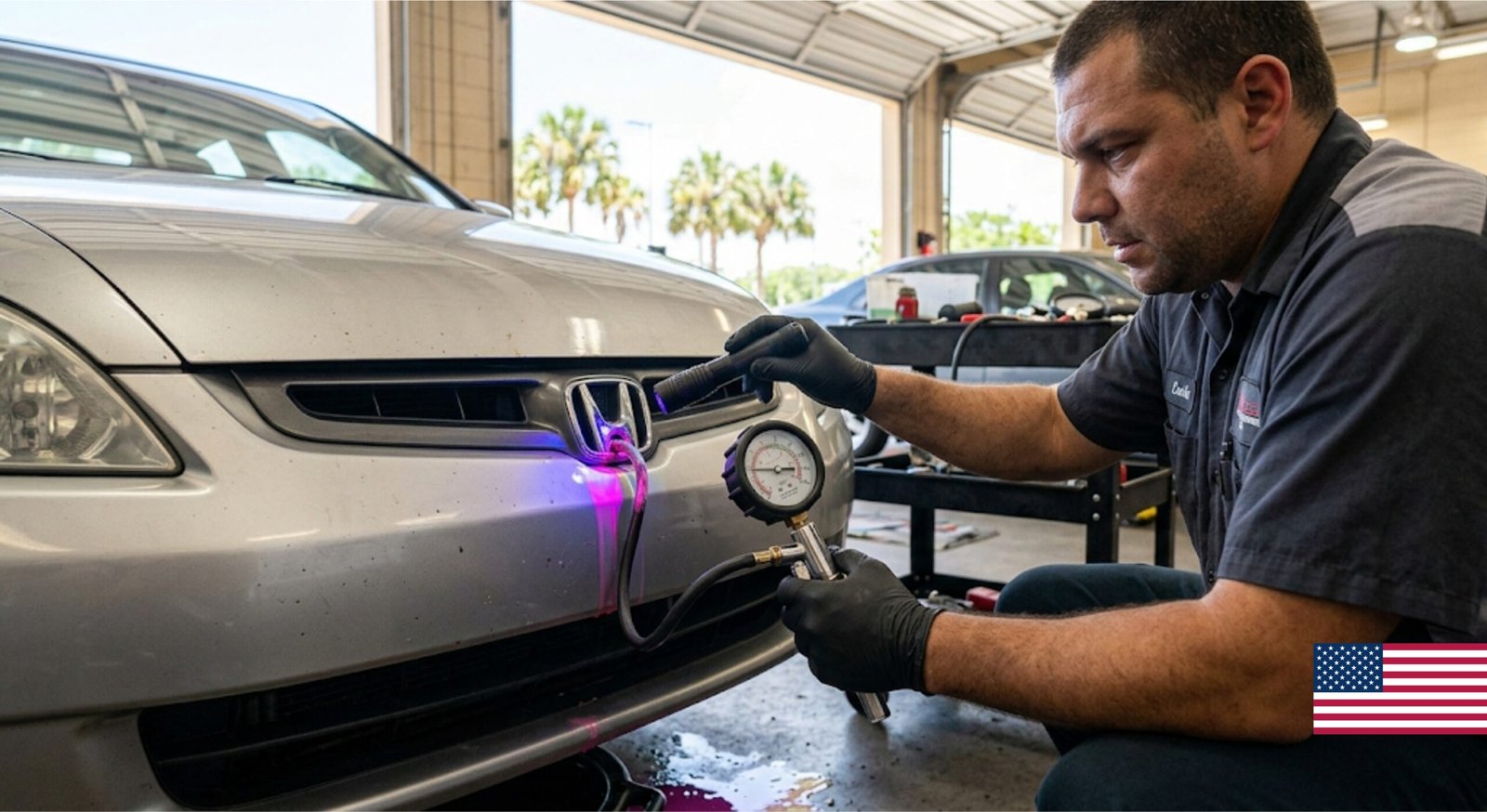
An experienced technician traces the leak with a pressure test and UV dye rather than guessing — this matters because a hose repair and a radiator replacement look similar from under the car but cost very differently.
This is a point where radiator repair cost decisions really matter — a correct call here avoids paying twice.
Coolant Flush vs. Radiator Replacement
When a Coolant Flush Is Enough
A coolant flush removes old, contaminated coolant and refills the system with fresh coolant at the correct mixture. It’s appropriate when the radiator itself is structurally sound but the coolant has broken down, picked up rust, or is simply overdue. Manufacturers typically recommend a flush every 30,000–60,000 miles, though hybrid coolant types vary — check your owner’s manual.
When You Need a Radiator Replacement
Replacement is necessary when the radiator core, end tanks, or seams are physically cracked, corroded, or clogged internally in a way that a flush can’t fix. Signs it’s time to replace rather than flush include repeated topping-off of coolant, visible cracks in the plastic tanks, or a radiator that’s already been patched once before.
This is a point where radiator repair cost decisions really matter — a correct call here avoids paying twice.
2026 Cooling System Repair Cost Guide (Orlando, FL)
| Service | Typical Cost Range |
|---|---|
| Coolant flush | $100 – $180 |
| Radiator hose replacement | $90 – $220 |
| Thermostat replacement | $180 – $320 |
| Full radiator replacement | $450 – $950 (trucks/imports can run higher) |
Actual pricing depends on your make and model, whether the radiator is OEM or aftermarket, and local labor rates. A shop that diagnoses the exact failure point before quoting you will usually save you money over a blanket “replace everything” estimate.
This is a point where radiator repair cost decisions really matter — a correct call here avoids paying twice.
Why Florida Heat and Traffic Are Hard on Cooling Systems
Orlando’s climate is uniquely tough on cooling systems. Ambient temperatures regularly hit the 90s for months at a time, and summer humidity means the air itself carries less capacity to help dissipate engine heat. Add in stop-and-go traffic on I-4, the 408, and surface streets during rush hour, and your radiator and fan are working overtime with less airflow to cool things down.
Hurricane season adds another wrinkle — vehicles that sit for evacuation prep or storm cleanup, then get pushed hard afterward, are more likely to reveal a marginal cooling system’s weaknesses at the worst possible time. Regular coolant checks before summer and before storm season are cheap insurance against a roadside breakdown.
MCS Mechanical is Orlando’s certified engine and transmission warranty specialist, backed by a Technet 24-month/24,000-mile parts and labor warranty on qualifying repairs. That matters for cooling system work specifically, because an overheated engine is one of the fastest ways to turn a small repair into a major one — getting it diagnosed correctly the first time protects both your wallet and your warranty coverage.
This is a point where radiator repair cost decisions really matter — a correct call here avoids paying twice.
Related reading: Engine warning signs to never ignore
For general vehicle safety and maintenance guidance, the National Highway Traffic Safety Administration (NHTSA) recommends addressing warning signs like these promptly rather than waiting for a breakdown.
Frequently Asked Questions
How do I know if it’s my radiator or my water pump leaking?
Both leaks pool coolant, but a water pump leak typically drips from the front-center of the engine near the pulleys, while a radiator leak comes from the front of the engine bay near the grille. A pressure test with UV dye pinpoints the exact source in minutes.
Is it safe to keep driving with a coolant leak?
Not for long. A slow leak can be monitored short-term if the level stays topped off and the gauge stays normal, but any leak paired with rising temperature or steam means you should stop driving and have it inspected before the engine overheats.
How often should I flush my coolant in Florida?
Most manufacturers recommend a flush every 30,000–60,000 miles, but Florida’s heat can shorten that interval. Have your coolant condition checked at every oil change so buildup and contamination get caught early.
Can I just add water instead of coolant if I’m low?
In an emergency, plain water is better than driving on empty, but it dilutes the coolant’s boiling point, freeze protection, and corrosion inhibitors. Get a proper 50/50 coolant mix added as soon as possible.
Seeing steam, smelling coolant, or watching your temperature gauge creep up? Call MCS Mechanical at 407-853-0002 or message us on WhatsApp for a same-week cooling system inspection before a small leak becomes an overheated engine.