
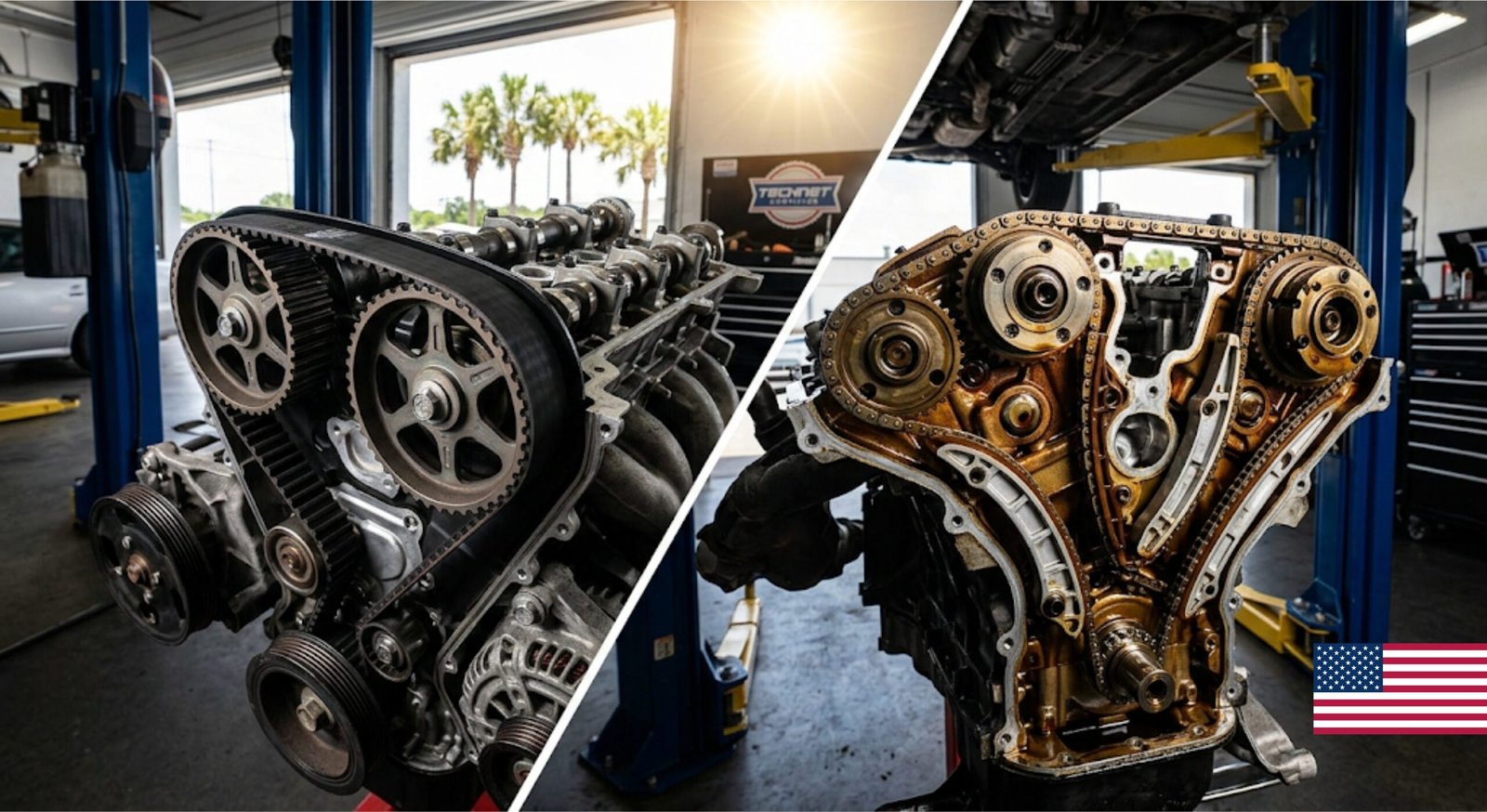
Understanding the difference between a timing belt vs timing chain is one of the most important things Orlando FL drivers can know about their engine. Choosing to replace a timing belt on schedule can be the difference between a routine service and a destroyed engine. At MCS Mechanical, our TechNet Certified technicians service both systems every week. This guide explains the difference, how to tell which one your car has, replacement intervals, what happens if it breaks, and 2026 costs. Call (407) 853-0002 with any questions.
Timing Belt vs Timing Chain: What’s the Difference?
Both a timing belt and a timing chain do the same job: they synchronize the crankshaft and camshaft so your engine’s valves open and close at exactly the right moment relative to the pistons. The difference is the material and lifespan. A timing belt is made of reinforced rubber, runs quietly, and must be replaced at a set interval. A timing chain is made of metal links (like a bicycle chain), runs inside the engine bathed in oil, and is generally designed to last the life of the engine — though it can still stretch or fail with poor maintenance.
How to Know Which One Your Car Has
There’s no universal rule — it depends on your make, model, and engine. In general, many newer vehicles and most V6/V8 engines use timing chains, while many older and economy four-cylinder engines use belts. The easiest ways to find out: check your owner’s manual maintenance schedule (a belt will have a replacement interval listed), look for a rubber cover on the front of the engine (belts) versus a metal cover (chains), or simply call MCS Mechanical at (407) 853-0002 with your year, make, and model and we’ll tell you for free.
Timing Belt Replacement Interval
Most manufacturers recommend replacing a timing belt every 60,000 to 100,000 miles, or every 7 to 10 years, whichever comes first. Always follow your specific vehicle’s schedule. Timing chains don’t have a fixed interval, but they rely on clean oil and a working tensioner, so regular oil changes are essential to chain longevity.
Why Florida Drivers Should Replace Belts Before 90,000 Miles
Heat is the enemy of rubber. Orlando’s year-round high temperatures and humidity dry out and degrade a rubber timing belt faster than in cooler climates, causing it to crack, glaze, or lose teeth before it would elsewhere. Combined with stop-and-go theme-park traffic that keeps engines hot, we strongly recommend Florida drivers replace timing belts toward the earlier end of the interval — typically before 90,000 miles — rather than pushing to the maximum.
What Happens If Your Timing Belt Breaks?
This is where it gets serious. Engines are either “interference” or “non-interference.” In an interference engine — which is the majority of modern engines — the valves and pistons share the same space at different times. If the timing belt snaps, the camshaft stops but the pistons keep moving, and they slam into open valves. The result is bent valves, damaged pistons, and often a destroyed cylinder head. This can turn a $600 belt service into a $3,000–$5,000+ engine repair. A non-interference engine may simply stop running, but you should never gamble on which type you have. According to the NHTSA, following your manufacturer’s maintenance schedule is key to vehicle safety and reliability.
Timing Belt & Chain Cost in Orlando FL (2026)
| Service | Estimated Cost (2026) |
|---|---|
| Timing belt replacement (4-cyl) | $400 – $900 |
| Timing belt replacement (V6/V8) | $700 – $1,500 |
| Timing belt + water pump kit | $600 – $1,800 |
| Timing chain replacement | $1,200 – $3,000 |
| Tensioner / idler pulley | $150 – $500 |
| Interference engine repair (after break) | $3,000 – $5,000+ |
Because the labor to reach the timing belt is significant, we recommend replacing the water pump and tensioner at the same time. For an exact quote, call (407) 853-0002 or contact us here.
Why Choose MCS Mechanical in Orlando
MCS Mechanical is a TechNet Certified shop at 2699 Old Winter Garden Rd, Orlando FL 32805. We service engines, transmissions, A/C, brakes, and diesel engines, and we work with major extended warranty providers including AGWS, NVP, Smart Autocare, AUL, Cars Protection Plus, Proguard, Protective, and Secure One. Our team speaks English, Portuguese, and Spanish. We’re open Monday–Friday 8am–6pm and Saturday 8am–2pm. See our warranty page or browse our services.
Frequently Asked Questions
How do I know if my timing belt is going bad?
Warning signs include a ticking noise from the engine, difficulty starting, engine misfires, or rough running. However, many belts fail with no warning, which is why the mileage interval matters most.
Is a timing chain better than a timing belt?
Chains last longer and don’t need scheduled replacement, but they’re more expensive to repair if they fail. Belts are cheaper but require periodic replacement. Neither is universally “better.”
How much does a timing belt cost in Orlando?
Typically $400–$900 for a four-cylinder and $700–$1,500 for a V6 or V8, more if the water pump is included. Call (407) 853-0002 for your exact quote.
Should I replace the water pump with the timing belt?
Usually yes. The water pump is often driven by the same belt, so replacing both together saves significant labor cost down the road.
Can a timing chain stretch?
Yes. Over many miles, and especially with neglected oil changes, a chain can stretch and trigger timing codes or rattling. Clean oil is the best prevention.
What if I don’t know my replacement history?
If there’s no record that the belt was replaced and you’re near the interval, replace it. The cost is minor compared to the engine damage a broken belt causes.
Don’t Risk Your Engine — Get Your Timing Checked
A timing belt is cheap insurance against a catastrophic engine failure. Let MCS Mechanical inspect and service your timing system. Call (407) 853-0002 or schedule your appointment online today.