
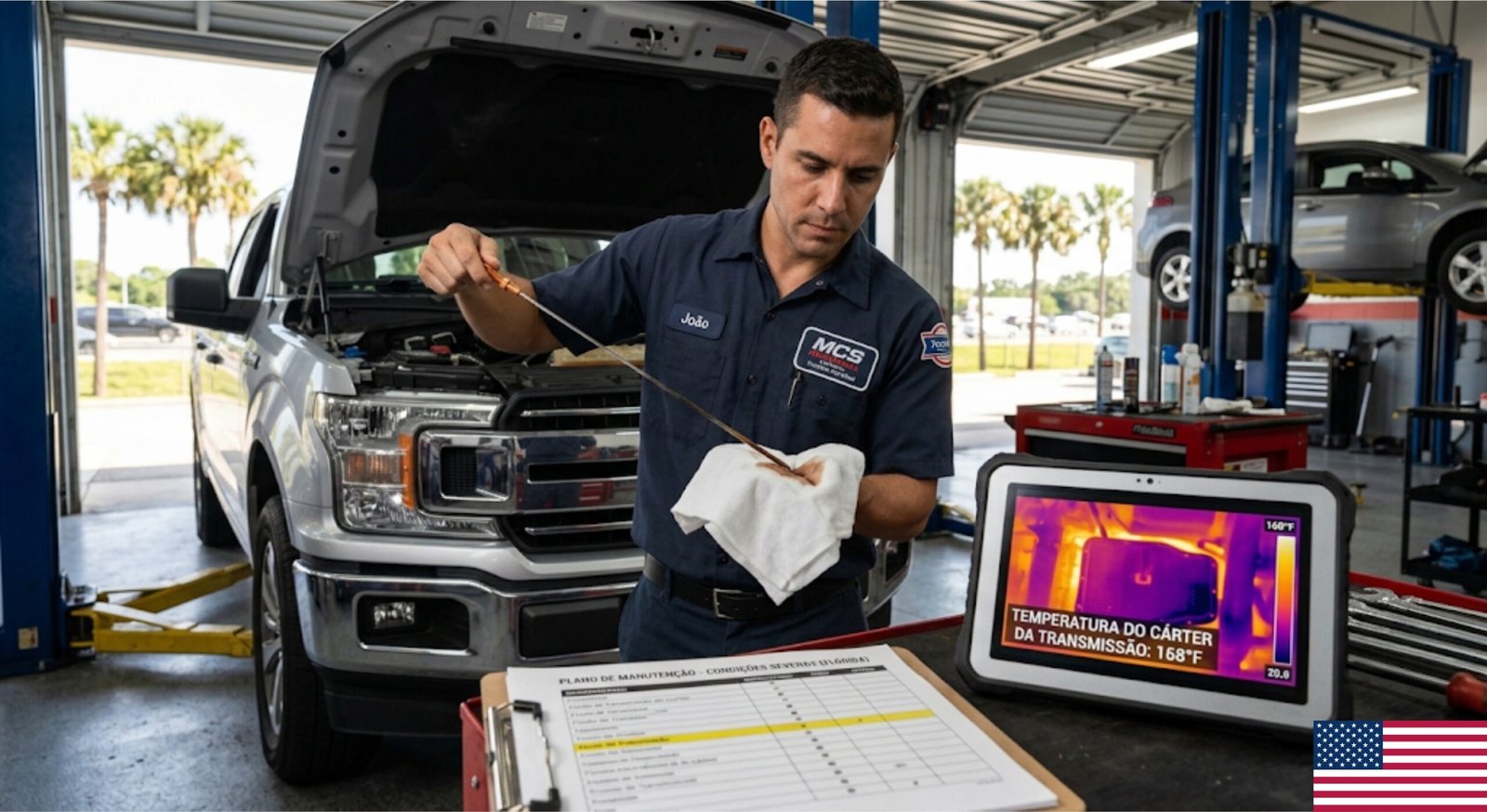
If you’re wondering how often you really need a transmission fluid change here in Central Florida, the honest answer is: probably more often than the sticker in your glove box suggests. Florida’s triple-digit pavement temperatures, relentless summer humidity, and the daily grind of Orlando’s tourist-corridor traffic and I-4 gridlock put more heat and stress on an automatic transmission than almost any other driving environment in the country. That extra heat breaks down transmission fluid faster than the ‘normal’ service intervals most manufacturers publish, which is one reason so many Orlando-area transmissions start slipping or shifting rough well before 100,000 miles.
At MCS Mechanical, we check transmission fluid condition on nearly every vehicle that comes through our shop at 2699 Old Winter Garden Rd, and the pattern is consistent: cars driven mostly around Orlando, Kissimmee, Winter Garden, and the theme park corridor are operating under ‘severe’ service conditions almost year-round, even though most owners assume their driving counts as ‘normal.’ This guide explains why Florida heat is so hard on transmission fluid, how to tell normal service from severe service, and how to recognize when your fluid is overdue.
Why Florida Heat and Orlando Traffic Wreck Transmission Fluid Faster
Automatic transmission fluid does a lot more than lubricate gears. It also acts as a hydraulic fluid, a coolant, and a carrier for the friction-modifying additives that let clutches and bands grip smoothly. All of that chemistry has a shelf life, and heat is the single biggest factor that shortens it.
Extreme Heat Speeds Up Fluid Oxidation
As a rule of thumb used across the auto industry, every 20-degree increase in operating temperature above a normal baseline can cut a fluid’s useful life roughly in half. In Orlando, asphalt surface temperatures regularly climb well above 140°F on a summer afternoon, and underhood and transmission temperatures climb right along with it. That heat accelerates oxidation, which thickens the fluid, breaks down its viscosity, and burns off the additives that protect clutch plates and seals. Once those additives are gone, metal-to-metal contact increases, varnish and sludge start forming inside valve bodies, and shift quality suffers long before the fluid looks obviously dirty.
Stop-and-Go I-4 and Tourist-Corridor Traffic Adds Constant Heat Cycles
Heat alone would be bad enough, but Orlando drivers rarely get the relief of steady highway cruising that keeps transmission temperatures stable. Crawling on I-4 through downtown, idling near International Drive, or inching through theme-park traffic keeps the torque converter working hard at low speeds with little airflow to cool the transmission cooler. Every stop, creep, and restart cycle spikes fluid temperature again. Combine that with Florida’s ambient heat and you get a transmission that runs hotter, more often, than the same vehicle would in a cooler, less congested market — which is exactly why fluid breaks down faster here than the national averages manufacturers use to set their ‘normal’ service charts.
Normal vs. Severe Service Schedules — Why Most Orlando Driving Is ‘Severe’
Every owner’s manual publishes two maintenance schedules: ‘normal’ service and ‘severe’ service. Most drivers assume they fall under the normal schedule because they aren’t off-roading or towing every day. In reality, manufacturers define severe service broadly, and a surprising number of everyday Orlando driving habits qualify, including:
- Frequent short trips of less than 10 miles, especially when the engine and transmission never fully warm up
- Extended idling or stop-and-go traffic, like the daily crawl on I-4 or around the theme parks
- Sustained high ambient temperatures, which describes nearly the entire Central Florida summer
- Occasional towing of a boat, trailer, or heavy cargo
- Frequent airport, delivery, rideshare, or commercial-style driving
If two or more of those describe your daily routine, your vehicle is almost certainly operating under severe service conditions, regardless of what you assumed when you bought the car. That single distinction is the biggest reason vehicles in Orlando need transmission fluid service on a shorter timeline than a similar car driven in a milder, less congested climate.
So How Often Should You Really Get a Transmission Fluid Change?
There’s no single universal number, and any blog that gives you one flat mileage figure is oversimplifying. Depending on the make, model, and transmission type, manufacturers spec transmission fluid changes anywhere from 30,000 miles to 100,000 miles under normal conditions. Traditional automatic transmissions on many domestic trucks and SUVs often call for service in the 30,000–60,000 mile range. Some modern automatics and CVTs are marketed as ‘lifetime fluid’ up to 100,000 miles or more — but that rating almost always assumes normal service, not the severe conditions most Orlando vehicles actually see.
Under severe conditions, that interval can shrink significantly — often to half of the normal-service number or less. This is exactly why we always tell customers: don’t rely on a generic rule of thumb you saw online. The correct interval is the one printed in your specific owner’s manual under the severe-service schedule, cross-referenced against your transmission type. If you’re not sure which schedule applies to your vehicle, our techs can look it up and check your fluid condition at the same time — schedule a visit through our Transmission Repair page or call us at (407) 853-0002.
Fluid Change vs. Full Flush: What’s the Difference?
Two different services often get lumped together, and picking the wrong one can matter.
A drain-and-fill (sometimes just called a fluid change) drains the fluid that’s sitting in the transmission pan, replaces the filter if applicable, and refills with fresh fluid. Because fluid also sits in the torque converter and cooler lines, a drain-and-fill typically replaces only 40–60% of the total fluid volume. It’s a lower-cost, lower-risk service that’s appropriate for most routine maintenance intervals, especially on vehicles with reasonably healthy fluid.
A full flush uses a machine to cycle fluid through the entire system — pan, torque converter, and cooler lines — under pressure, exchanging nearly all of the old fluid for new. That sounds like the more thorough option, and on many vehicles with a solid maintenance history, it is. However, flushes aren’t recommended for every vehicle or transmission design. On units that have gone a long time without service, or on certain CVT and older high-mileage transmissions, sludge and worn friction material can build up inside the valve body and clutch packs. A high-pressure flush can dislodge that debris and push it into narrow fluid passages or solenoids, sometimes triggering shift problems or a failure that wasn’t there before. Some manufacturers explicitly warn against pressure-flushing certain transmission designs for this reason. That’s why a technician should evaluate fluid condition and service history before recommending a flush over a simple change — it isn’t a one-size-fits-all decision.
Signs Your Transmission Fluid Change Is Overdue
Your vehicle usually gives warning signs before a transmission problem turns into a costly repair.
Fluid Color and Smell
Healthy automatic transmission fluid is typically bright red or pink and translucent enough to see through when checked on a dipstick or during a pan inspection. As fluid ages and oxidizes, it darkens to a deep brown or black and loses that translucency. A sharp, burnt smell is one of the clearest red flags — it usually means the fluid’s additive package has broken down and friction material is being scorched inside the transmission. Fluid that smells burnt should be checked immediately, not on your next regular oil change visit.
Delayed or Rough Shifting
When fluid loses its ability to build proper hydraulic pressure, you may notice a delay between pressing the gas and feeling the transmission engage, a hard clunk between gears, hesitation on acceleration, or an engine RPM flare that doesn’t match your road speed. These symptoms can also point to a mechanical transmission issue, which is exactly why a proper inspection — not guesswork — is the right next step.
The table below gives general guidance on how typical driving conditions around Orlando line up with normal versus severe service classifications.
| Driving Condition | Normal or Severe | Suggested Check Frequency |
|---|---|---|
| Mostly steady highway driving, mild weather | Normal | Every 60,000–100,000 miles (per owner’s manual) |
| Daily mixed city/highway driving in Orlando traffic | Severe | Every 30,000–45,000 miles |
| Frequent stop-and-go near I-4, Downtown, or the parks | Severe | Every 25,000–30,000 miles |
| Frequent short trips (under 10 miles) in Florida heat | Severe | Every 30,000 miles |
| Towing a trailer, boat, or heavy cargo | Severe | Every 15,000–25,000 miles |
| High-mileage vehicle (100,000+ miles) with no known fluid history | Severe by default | Inspect now, then every 20,000–30,000 miles |
These ranges are general guidance, not a replacement for your owner’s manual. Transmission type, fluid formulation, and manufacturer design all shift the exact number, which is why we always confirm the correct interval against your vehicle’s specific severe-service chart before recommending a service.
How MCS Mechanical Checks Your Transmission Fluid
As a TechNet Certified shop, our technicians inspect fluid color, smell, and level as a standard part of any transmission evaluation, and we check for contamination, metal shavings, or a burnt odor that can point to deeper wear. We’ll also pull up your vehicle’s manufacturer service schedule to see whether your driving habits place you under normal or severe classification, and we’ll road test the vehicle to confirm shift quality matches what the fluid condition suggests. If a repair turns out to be necessary, all of MCS Mechanical’s own repair work is backed by a 24-month parts and labor warranty, and our team communicates in English, Portuguese, and Spanish so you can describe what you’re noticing in whichever language you’re most comfortable with. You can review our full process on the Transmission Repair service page.
Frequently Asked Questions
How much does a transmission fluid change cost in Orlando?
Cost depends on your vehicle’s transmission type, fluid capacity, and whether a drain-and-fill or full flush is appropriate. Call us at (407) 853-0002 with your year, make, and model, and we can give you an accurate estimate.
Can I just check the transmission fluid myself?
Many newer vehicles have sealed transmissions without a customer-accessible dipstick, so checking level and condition safely often requires a lift and the correct procedure for your model. If your dashboard hasn’t warned you and you’re unsure how to check it, it’s safer to have it inspected during a routine visit.
Does Florida heat really make that much of a difference?
Yes. Heat is the single biggest accelerant of fluid oxidation and additive breakdown. Combined with Orlando’s stop-and-go traffic patterns, vehicles here often need fluid service on a noticeably shorter interval than the same model driven in a cooler, less congested area.
Is a transmission flush bad for my car?
Not inherently, but it isn’t right for every vehicle. On transmissions with a long-neglected service history or certain CVT designs, a high-pressure flush can dislodge sludge and debris that then clogs narrow passages. We evaluate your fluid condition and service history before recommending a flush versus a standard drain-and-fill.
What happens if I never change my transmission fluid?
Degraded fluid loses the ability to lubricate and build hydraulic pressure properly. Over time this leads to rough or delayed shifting, overheating, accelerated wear on clutch packs and bands, and eventually a transmission failure that costs far more to repair or replace than routine fluid service ever would.
How do I know if I need a fluid change or a full transmission repair?
Mild delays or slightly darkened fluid often resolve with a proper fluid service. Slipping, grinding, burnt-smelling fluid combined with harsh shifts, or warning lights usually point to a deeper mechanical issue. A hands-on inspection is the only reliable way to tell the difference, which is why we recommend booking a check rather than guessing.
Can I get service in Portuguese or Spanish at MCS Mechanical?
Yes. Our team speaks English, Portuguese, and Spanish, so you can explain what your vehicle is doing in whichever language is easiest for you.
Schedule Your Transmission Fluid Check in Orlando
If it’s been a while since your last transmission service — or you’re simply not sure whether your driving counts as ‘normal’ or ‘severe’ — don’t wait for a warning light. Bring your vehicle to MCS Mechanical at 2699 Old Winter Garden Rd, Orlando, FL 32805 for a fluid condition check. As a TechNet Certified shop backed by a 24-month parts and labor warranty on our repair work, we’ll give you a straight answer on whether you need a simple drain-and-fill, a full flush, or nothing at all yet. Call us today at (407) 853-0002 or request an appointment through our Contact page. We’re open Monday–Friday 8am–6pm and Saturday 8am–2pm.